About this climb
The Lemosho Route is widely regarded as the finest way to climb Kilimanjaro. Beginning on the remote western slopes far from the more crowded Machame and Marangu starting points, it traverses the full width of the mountain — crossing five distinct climate zones from equatorial rainforest through heather moorland, alpine desert, and finally the arctic glacial summit zone.
The 8-day itinerary provides exceptional acclimatization time, including a deliberate "climb high, sleep low" day on the Shira Plateau. This extended schedule is the primary reason our summit success rate consistently exceeds 92%. You will spend genuine time in each environment, allowing your body to adjust gradually to the altitude.
Resilience Expedition provides all technical safety equipment, professional KPAP-certified guides and porters, full-board camping meals, and a pre-climb briefing the evening before departure. Porters are compensated above the industry Fair Wage standard.
8-day itinerary
-
Welcome to Moshi — the gateway city to Kilimanjaro. After airport pickup and check-in at your lodge, your lead guide holds a thorough pre-climb briefing: packing strategy, altitude awareness, hydration protocols, and summit night psychology.
- ArrivalAirport / hotel pickup
Transfer from Kilimanjaro International Airport (JRO) to your Moshi lodge. Rest and acclimatize to 900 m.
- 15:00Gear check
Team distributes and checks all rental equipment — gaiters, trekking poles, sleeping bags, and summit layers. Final gear purchases at the Moshi gear shops if needed.
- 18:00Pre-climb briefing
Full team orientation with your lead guide. Route overview, altitude protocol, camp rules, porter introductions, and Q&A.
- 19:30Group dinner & early rest
High-carbohydrate dinner at the lodge. Lights out early — 4:00 AM the next morning comes quickly.
🏨 Overnight: Moshi Lodge ⛰ 900 m altitude -
The journey begins. A 2-hour drive from Moshi to the remote Londorossi Gate for registration, then a short vehicle transfer into the forest to the Lemosho Glades trailhead. You immediately enter some of the most spectacular montane rainforest in Africa.
- 06:00Depart Moshi
Early pickup from your lodge. Drive ~2 hrs to Londorossi Gate (2,100 m) for park entry registration and porter loading.
- 08:30Enter the rainforest
Begin hiking through ancient montane forest. Watch for colobus monkeys, blue monkeys, and a rich variety of bird species in the canopy above.
- 13:00Lunch break
Hot lunch served on the trail by your camp crew.
- 15:30Arrive Big Tree Camp
Camp at 2,650 m amid towering Hagenia trees draped in old-man's beard lichen. Dinner and altitude briefing from guide.
📍 ~9 km distance ⏱ 5–6 hrs hiking ⛰ 1,600 m → 2,650 m ⛺ Big Tree Camp -
You break out of the forest and into Kilimanjaro's iconic heather moorland — an otherworldly landscape of giant heathers, lobelias, and senecio groundsels. Your first direct views of the summit cone appear as you approach the Shira Plateau.
- 07:00Breakfast & depart camp
Packed breakfast, then strike camp and head north-east through the heather zone.
- 10:30Forest edge — first Kibo views
Emerge from the treeline onto open moorland. Clear days reward with your first unobstructed view of Kibo's snow-capped summit.
- 13:30Shira 1 Camp arrival
Arrive on the Shira Plateau at 3,500 m. The plateau is an ancient volcanic caldera — an eerie flat landscape surrounded by ridges. Hot lunch and rest.
- 15:30Acclimatization hike
Short optional hike to higher ground (3,700 m) — "climb high, sleep low." Return to camp for dinner.
📍 ~11 km distance ⏱ 5–7 hrs hiking ⛰ 2,650 m → 3,500 m ⛺ Shira 1 Camp -
The most important acclimatization day of the entire climb. You ascend to the Lava Tower at 4,630 m — above the altitude of Mont Blanc — for lunch, then descend to Barranco Camp at 3,960 m. This "climb high, sleep low" profile is why the Lemosho Route dramatically outperforms shorter itineraries.
- 07:30Depart Shira 1, cross Shira Plateau
Trek across the vast Shira Plateau with spectacular views of Kibo ahead. Pass Shira 2 Camp en route.
- 11:30Lava Tower — 4,630 m
Arrive at the dramatic 300-metre volcanic lava plug. Altitude effects may be noticeable here — headache, breathlessness. Pace yourself. Hot lunch at the tower base.
- 13:30Descend to Barranco Camp
A long descent through the spectacular Great Barranco Valley to Barranco Camp at 3,960 m. The descent relieves altitude symptoms and triggers red blood cell production.
- 17:00Barranco Camp — rest & dinner
Spectacular views of the glaciers above and the Barranco Wall ahead. Your guide walks the team through tomorrow's wall scramble.
📍 ~14 km distance ⏱ 7–8 hrs hiking ⛰ 3,500 m → 4,630 m → 3,960 m ⛺ Barranco Camp -
Today features the most exciting section of the entire route — the Barranco Wall. A 300-metre rocky scramble (hands and feet, non-technical) that climbers consistently describe as the highlight of their Lemosho experience. Your guides lead you step by step up the wall.
- 07:00Approach the Barranco Wall
Cross the valley floor and begin the wall ascent. Hands-on-rock scrambling with guides positioned above and below for safety. Takes approximately 1.5–2 hours.
- 10:30Above the wall — panoramic views
Pause on top of the wall for one of Kilimanjaro's greatest viewpoints. Southern glaciers directly ahead, clouds below.
- 12:30Arrive Karanga Camp
Short but steep final approach to Karanga Camp at 3,995 m. Lunch, rest, and altitude monitoring.
- 15:00Rest & mental preparation
Shorter hiking day intentional — conserve energy for the coming summit push. Guide gives summit night briefing.
📍 ~6 km distance ⏱ 4–5 hrs hiking ⛰ 3,960 m → 3,995 m ⛺ Karanga Camp -
A crucial shorter day. You arrive at Barafu — the summit launch camp — early enough to rest properly before the midnight start. Every hour of sleep and hydration here directly increases your summit chances.
- 08:00Depart Karanga
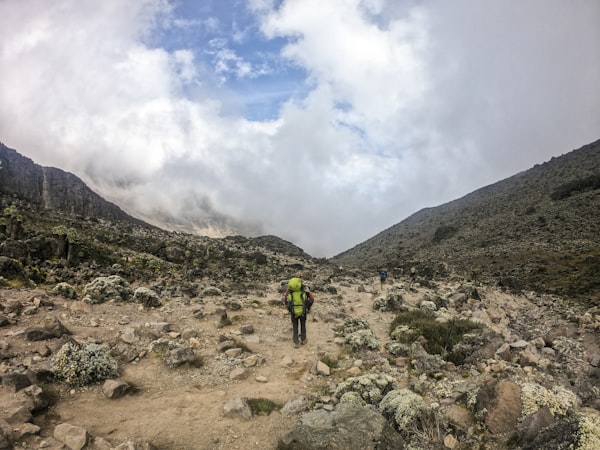
Trek north-east across alpine desert terrain — barren, rocky, and increasingly exposed. The landscape now feels truly alien.
- 12:30Arrive Barafu Base Camp
Barafu ("ice" in Swahili) sits at 4,673 m between the Rebmann and Ratzel glaciers. Lunch and immediate rest.
- 16:00Summit night briefing
Guide walks through the full summit push protocol — starting time, pace, turn-back criteria, layering system, and headlamp check.
- 17:30Early dinner & sleep
High-calorie dinner. Sleep as much as possible. You will be woken at 23:00.
📍 ~5 km distance ⏱ 4–5 hrs hiking ⛰ 3,995 m → 4,673 m ⛺ Barafu Base Camp -
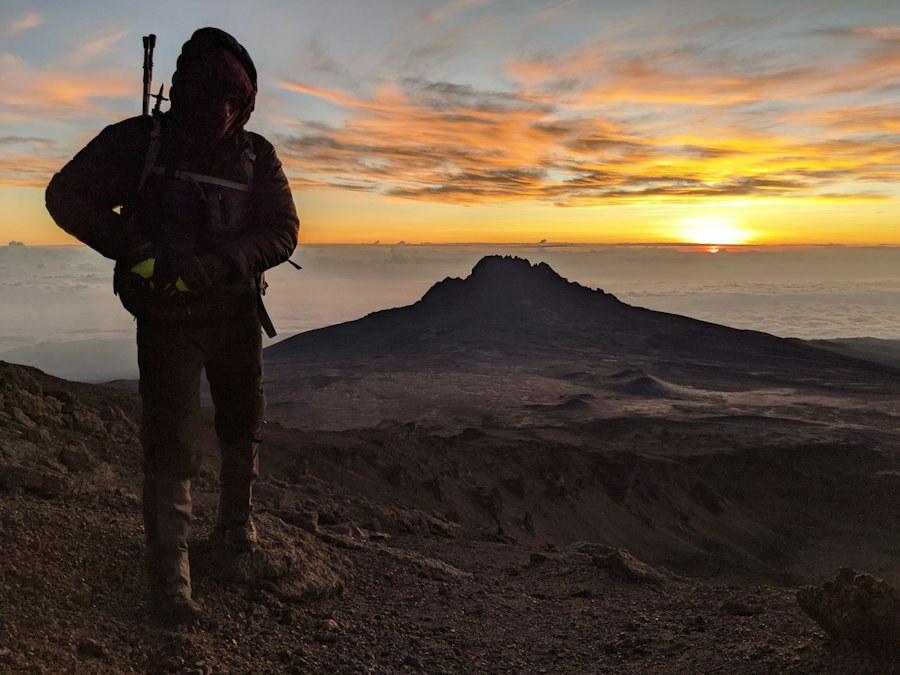
The night you have trained for. Departing at midnight in total darkness, you ascend by headlamp through the scree and glacial moraine to Stella Point on the crater rim, then walk the final 200 m along the rim to Uhuru Peak — the Roof of Africa at 5,895 m. A descent to Mweka Camp follows the same day.
- 23:00Wake up — begin summit push
Tea, biscuits, and final layer check. Headlamps on. The temperature will be −10°C to −20°C at the summit. Poles in hand.
- 04:30Stella Point — Crater Rim (5,745 m)
The hardest section complete. First light begins to colour the horizon. A brief rest before the final push along the crater rim.
- 06:00UHURU PEAK — 5,895 m
The Roof of Africa. Sunrise over a sea of clouds stretching to the Indian Ocean. Photographs at the famous summit sign. Allow the moment to arrive fully.
- 07:30Begin descent to Mweka Camp
The descent is long and physically demanding on tired legs. Take it slowly. Arrive Mweka Camp (3,100 m) in the afternoon for a well-earned final night on the mountain.
📍 ~16 km (up & down) ⏱ 10–14 hrs total ⛰ 4,673 m → 5,895 m → 3,100 m ⛺ Mweka Camp -
The final day. A gentle descent back through the rainforest to Mweka Gate, where your TANAPA summit certificate awaits. Your porters' singing farewell is one of the most memorable moments of the entire climb.
- 07:30Final breakfast at Mweka Camp
A relaxed morning. Sign porters' tip register and share final goodbyes with the mountain crew.
- 08:30Descend to Mweka Gate
3–4 hour walk through the rainforest zone. Knees feel every metre — trekking poles essential.
- 12:30Mweka Gate — certificate presentation
Your official TANAPA Kilimanjaro summit certificate is presented at the gate. Porters perform a traditional farewell song.
- 14:00Return to Moshi — celebration dinner
Hot shower, rest, then a group celebration dinner at a Moshi restaurant. End of services.
📍 ~9 km descent ⏱ 3–4 hrs hiking ⛰ 3,100 m → 1,640 m 🏨 Return to Moshi
Choose your package
All three packages follow the identical 8-day Lemosho Route itinerary. The difference is your pre- and post-climb hotel accommodation and the private-vs-group guide ratio.
- Budget guesthouse in Moshi (D1 & D8)
- All park, camping & rescue fees
- Professional KPAP-certified guide
- All porters & camp cook
- 3 meals/day + snacks on mountain
- Safety oxygen cylinder on route
- Pulse oximeter monitoring daily
- TANAPA summit certificate
- Mid-range hotel in Moshi (D1 & D8)
- All park, camping & rescue fees
- Dedicated experienced lead guide + assistant
- All porters, cook & waiter
- 3 meals/day + hot drinks + snacks
- Safety oxygen & Gamow bag on route
- Pulse oximeter monitoring twice daily
- Airport transfers included
- TANAPA summit certificate
- Boutique hotel in Moshi (D1 & D8)
- All park, camping & rescue fees
- Dedicated private lead guide (1:1 or 1:2)
- All porters, cook, waiter & toilet tent
- 3 restaurant-quality meals + full snack bar
- Safety oxygen, Gamow bag & AED
- Pulse oximeter monitoring 3× daily
- Airport transfers + Moshi tour
- Optional Safari add-on pricing
What's included
- All TANAPA park and conservation fees
- Camping fees for all 6 nights on the mountain
- Professional KPAP-certified lead guide
- Assistant guide (1 per 3 climbers)
- Porters (ratio ~3 porters per climber)
- Camp cook and all mountain meals
- Emergency supplemental oxygen cylinder
- Pulse oximeter and daily health monitoring
- High-altitude mountain tent & dining tent
- TANAPA summit certificate on completion
- Rescue fee contribution (KINAPA)
- International flights to Kilimanjaro (JRO)
- Tanzania tourist visa (~$50 USD)
- Personal travel & medical insurance
- Personal hiking gear (rentals available)
- Gratuities for guides and porters
- Alcoholic beverages
- Personal snacks & supplements
- Altitude medication (Diamox) — consult doctor
Essential gear checklist
Kilimanjaro requires clothing for tropical rainforest (warm & wet) through to arctic summit conditions (−20°C). The layering system is everything.
| Category | Items | Status |
|---|---|---|
| Footwear | Waterproof hiking boots (broken in), camp sandals, gaiters, wool socks ×5 | Essential |
| Base layers | Moisture-wicking thermal top & bottom ×2, lightweight long-sleeve shirts ×3 | Essential |
| Insulation | Down jacket or heavy synthetic jacket (−15°C rated), fleece mid-layer | Essential |
| Shell | Waterproof/windproof jacket & trousers (Gore-Tex or equivalent) | Essential |
| Extremities | Warm hat (wool/fleece), sun hat, balaclava, liner gloves, summit mitts | Essential |
| Trekking poles | 2× adjustable trekking poles (rentals available from Resilience Expedition) | Strongly rec. |
| Daypack | 20–30L daypack (porters carry main bag) | Essential |
| Sleeping bag | −15°C rated (4-season) sleeping bag (rentals available) | Essential |
| Hydration | 2× 1L water bottles or 3L hydration bladder, water purification tablets | Essential |
| Sun protection | SPF 50+ sunscreen, UV-blocking sunglasses, lip balm SPF | Essential |
| Headlamp | Bright headlamp + 2× spare batteries (summit night is in total darkness) | Essential |
| Other | Blister treatment, altitude sickness medication (Diamox — prescr.), camera | Recommended |
Best time to climb
Kilimanjaro can be climbed year-round, but weather windows significantly affect summit success rates and trail conditions.
| Months | Season | Summit conditions | Crowds | Price |
|---|---|---|---|---|
| Jan – Feb | Dry & cold | Excellent | Moderate | Standard |
| Mar – May | Long rains | Poor – avoid | Low | Discounted |
| Jun – Oct | Dry (peak season) | Excellent | High | Peak |
| Nov | Short rains | Acceptable | Low | Discounted |
| Dec | Dry & cold | Excellent | Moderate | Standard |
Frequently asked questions
-
Prices range from $2,200 (standard group) to $3,200 (private luxury) per person. All packages include park fees, camping fees, rescue fees, all guides and porters, mountain meals, and safety equipment. International flights and visas are not included.
-
The Lemosho Route offers the longest acclimatization profile, the most diverse scenery (crossing all five climate zones), the fewest climbers on the western approach, and the highest summit success rate of any Kilimanjaro route. The 8-day itinerary includes a critical "climb high, sleep low" acclimatization day that shorter routes skip.
-
No technical climbing experience or equipment is needed. Kilimanjaro is a trek, not a climb. You should be able to hike 6–8 hours per day on consecutive days carrying a 15–20L daypack. Cardiovascular fitness matters most. We recommend 3–4 months of consistent cardio training (hiking, running, cycling) before your climb date.
-
Our 8-day Lemosho Route achieves approximately 92% summit success. The overall Kilimanjaro average is around 65%. The difference comes entirely from acclimatization time — the extra days allow climbers' bodies to produce additional red blood cells and adjust to reduced oxygen levels before the summit push.
-
Diamox (acetazolamide) can help with acclimatization but is a prescription medication with potential side effects. Consult your doctor at least 6 weeks before departure. Our guides do not prescribe or administer medication, but we do monitor your oxygen saturation daily with a pulse oximeter and will make descent decisions based on your readings.
-
Yes. Resilience Expedition is a registered KPAP (Kilimanjaro Porters Assistance Project) partner. All porters receive wages above the KPAP fair wage standard, are provided with appropriate clothing and equipment, are never overloaded beyond TANAPA weight limits, and are covered by health and accident insurance. Porter welfare is non-negotiable for us.