
About this climb
The Lemosho Route is universally regarded as Kilimanjaro's most scenic, most remote, and most rewarding climbing experience. Starting far to the west at Londorossi Gate (2,360 m) — deep in a rarely-visited section of the national park — it provides the longest possible traverse of the mountain, crossing all five climate zones and offering perspectives on Kibo's summit cone that no other route can match.
The 7-day itinerary covers the complete Lemosho experience — remote forest entry, the dramatic Shira Plateau crossing, the "climb high, sleep low" Lava Tower acclimatization day, the iconic Barranco Wall scramble, the high-camp ascent to Barafu, and the summit night. It differs from the 8-day only in spending one night on the Shira Plateau rather than two. For fit climbers with prior high-altitude experience, the 7-day Lemosho is an outstanding choice.
Londorossi Gate is 2.5 hours further from Moshi than the Machame Gate — and dramatically more remote. The forest at this elevation is pristine and visited by very few climbing groups. Colobus monkeys, elephants, and buffalo have been sighted in this forest zone. The remoteness alone makes the Lemosho a completely different quality of experience from the busier southern routes.
Day 5 brings the famous Barranco Wall — a 300-metre exposed rock scramble requiring hands and feet. Non-technical, no ropes, guides positioned throughout. The view from the top, with the Southern Glaciers directly ahead and the Barranco Valley far below, is one of Kilimanjaro's most spectacular moments. Every Lemosho climber cites it as unforgettable.
If you have prior high-altitude experience (above 4,000 m) and excellent cardiovascular fitness, the 7-day Lemosho is a superb choice with an ~88% success rate. If this is your first high-altitude climb or you have any flexibility in your schedule, we recommend the 8-day Lemosho Route — the extra Shira Plateau night costs approximately $150 more and one additional day, but raises success rates to ~92%.
7-day itinerary
-
A long but magnificent drive west from Moshi (approximately 2.5 hours) delivers you to the remote Londorossi Gate, where Kilimanjaro's western forest begins. You are immediately enveloped in some of the most pristine montane forest on the entire mountain — the Lemosho forest receives very few visitors and it shows. Today's hike is short and gentle, a perfect introduction.
-
07:00Depart Moshi for Londorossi Gate
~2.5 hour drive west across the lower Kilimanjaro foothills. Views of the western face of the mountain — a very different perspective from the usual southern photos.
-
10:00Londorossi Gate (2,360 m) — register and begin
Park registration. Enter the western forest immediately. Very quiet — very few other groups use this gate. Colobus monkeys, blue monkeys, and forest birds are common sightings.
-
13:30Arrive Big Tree Camp (2,780 m)
Named for the cathedral-sized Podocarpus trees nearby. Short day — good for adjusting to camp life and altitude. Dinner, hot drinks, first oxygen saturation reading.
- 📍 ~7 km
- ⏱ 3–4 hrs
- ⛰ 2,360 m → 2,780 m
- ⛺ Big Tree Camp
-
-
Today's ascent takes you out of the forest and onto the edge of the Shira Plateau — Kilimanjaro's ancient western volcanic peak, now collapsed and eroded into a vast highland caldera. The transition from dense forest to open moorland happens suddenly, and the view that opens ahead — Kibo's full summit cone rising against the sky — is one of Kilimanjaro's defining moments.
-
07:30Depart Big Tree Camp — ascend to ridge
Steep climb out of the forest. Giant heathers appear as altitude increases. Erica and protea shrubs mark the treeline transition.
-
11:00Exit forest — Shira Plateau edge
Emerge from the last trees onto the Shira Plateau. Kibo's complete summit cone suddenly visible across the plateau. A remarkable first view seen by very few climbers from this angle.
-
14:30Arrive Shira 1 Camp (3,500 m)
First Shira Plateau camp. Expansive views in all directions — Kenya to the north, the Tanzanian plains to the south, and Kibo ahead. Afternoon rest and altitude monitoring.
- 📍 ~9 km
- ⏱ 5–7 hrs
- ⛰ 2,780 m → 3,500 m
- ⛺ Shira 1 Camp
-
-
The most physiologically important day of the route — and one of the longest. You cross the Shira 2 area, ascend to the dramatic Lava Tower (4,630 m) for the crucial acclimatization lunch, then descend into the Great Barranco Valley to camp at 3,960 m. The "climb high, sleep low" profile of this day is the primary reason the Lemosho has such exceptional summit success rates.
-
07:30Cross the Shira Plateau — east toward Kibo
Trek across the ancient plateau past the Shira Cathedral volcanic ridge, through the wild landscape of giant heathers, lobelias, and open moorland.
-
10:30Shira 2 Camp (3,840 m) — brief stop
Leave gear at Shira 2 (where the 8-day option sleeps an extra night). On the 7-day you continue directly up toward the Lava Tower, taking lunch supplies with you.
-
13:00Lava Tower — 4,630 m (lunch & rest)
Reach the dramatic volcanic plug. Higher than Mont Blanc's summit. Altitude effects may be noticeable. Eat and rest here for 45–60 minutes.
-
15:00Descend to Barranco Camp (3,960 m)
Long descent into the spectacular Barranco Valley. The wall rises sheer ahead — tomorrow's challenge. Altitude discomfort eases on the descent.
-
18:00Dinner & Barranco Wall briefing
Guide walks the team through tomorrow's wall ascent step by step.
- 📍 ~16 km
- ⏱ 7–9 hrs
- ⛰ 3,500 m → 4,630 m → 3,960 m
- ⛺ Barranco Camp
-
-
The Barranco Wall. The moment every Lemosho climber anticipates. After crossing the valley floor you begin the 300-metre exposed rock scramble — hands and feet, no ropes, guides positioned throughout. The views from the top are extraordinary: the Southern Glaciers directly ahead, the Barranco Valley far below, and Kibo's summit cone rising close above. Universally cited as the best moment of the entire climb. A relatively short day ends at Karanga Camp.
-
07:00Cross the valley — begin the wall
Cross the Barranco riverbed and face the wall. Guides lead from the front; others position alongside. Take your time — the scramble takes 1.5–2 hours. It is thrilling, not frightening.
-
09:30Summit of the wall — extraordinary panorama
Emerge at the top. The Southern Glaciers are directly in front. The Great Barranco Valley below. The entire southern face of Kibo stretched out. Rest, breathe, absorb it.
-
12:30Arrive Karanga Camp (3,995 m)
A relaxed afternoon for recovery. Last significant water point — fill all bottles. Tomorrow ascends to Barafu and then the summit. Rest completely.
- 📍 ~6 km
- ⏱ 4–5 hrs
- ⛰ 3,960 m → 3,995 m
- 🧗 Barranco Wall scramble
- ⛺ Karanga Camp
-
-
A short, critical day. Arriving at Barafu early maximises rest before the midnight summit push. Every hour of sleep, every litre of water consumed, and every calorie eaten today directly improves your summit performance tonight. Do nothing strenuous once you arrive.
-
07:30Depart Karanga — ascend to Barafu
Short but relentless climb through the rocky alpine desert. Air noticeably thin. Move deliberately. The summit cone fills the sky.
-
11:30Arrive Barafu Base Camp (4,673 m)
Perched dramatically between two glaciers. Lunch immediately, then absolute rest until dinner.
-
16:00Full summit night briefing
Guide covers the complete push: 23:00 wake-up, layering system, pace, hydration, turn-back criteria, emergency protocols. Dinner and sleep by 18:00.
- 📍 ~4 km
- ⏱ 3–4 hrs
- ⛰ 3,995 m → 4,673 m
- ⛺ Barafu Base Camp
-
-
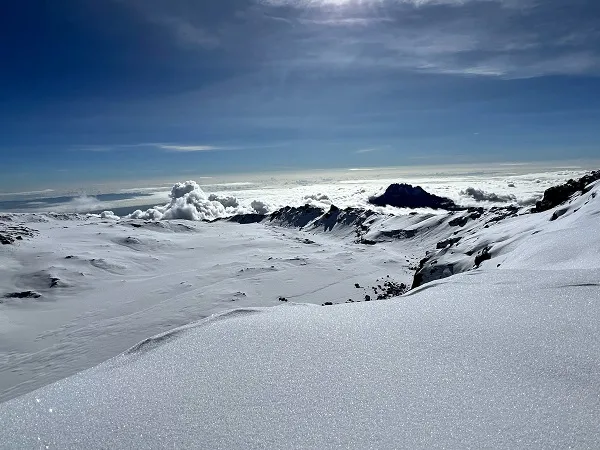
Everything you have prepared for and climbed toward. Midnight departure by headlamp, ascending the scree and volcanic rock toward Stella Point on the crater rim, then walking the rim to Uhuru Peak — the highest point in Africa — in time for a sunrise unlike anything on earth. A long, triumphant descent to Mweka Camp follows.
-
23:00Wake up — begin the summit push
Hot tea, biscuits, final layer check. Temperature −10°C to −20°C near the summit. Headlamps on. One step at a time. Pole pole.
-
05:00Stella Point — Crater Rim (5,745 m)
The hardest section done. First dawn light on the horizon. Short rest, then the final 45-minute walk along the crater rim. TANAPA certificate available here for those who cannot continue.
-
06:15UHURU PEAK — 5,895 m 🏔
The Roof of Africa. Full sunrise over the clouds. The famous yellow summit sign. The glaciers glow copper and gold. Your guide takes your photograph. Allow the moment entirely — this is why you came.
-
08:00Begin descent to Mweka Camp (3,100 m)
Long descent via the Mweka descent trail. Collect gear at Barafu on the way down. Trekking poles essential. Arrive Mweka Camp in mid-afternoon.
- 📍 ~18 km total
- ⏱ 12–15 hrs
- ⛰ 4,673 m → 5,895 m → 3,100 m
- ⛺ Mweka Camp
-
-
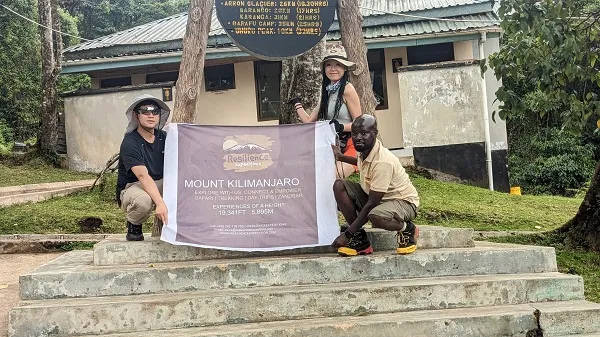
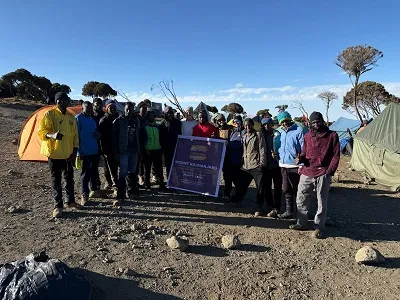
The final descent through the rainforest to Mweka Gate, where your official TANAPA summit certificate awaits. The porter farewell song at the gate is always deeply moving — a spontaneous, heartfelt celebration of shared achievement that brings many climbers to tears.
-
07:30Final breakfast & porter goodbyes
Unhurried last morning. Sign the porter tip register. Say farewell to each crew member personally — they made every step possible.
-
08:30Descend to Mweka Gate through rainforest
3–4 hour walk through the southern forest. Tired but euphoric. Trekking poles on steep sections.
-
12:30Mweka Gate — certificate presentation
Your TANAPA Kilimanjaro Summit Certificate. The porter farewell song. Karibu sana — you climbed Africa via its most beautiful route.
-
14:00Return to Moshi — celebration dinner
Hot shower, rest, and a well-earned group dinner. End of all services.
- 📍 ~9 km
- ⏱ 3–4 hrs
- ⛰ 3,100 m → 1,640 m
- 🏨 Return to Moshi
-
Choose your package
All packages follow the identical 7-day Lemosho Route itinerary with tented camping. The tier affects hotel comfort, guide ratio, and equipment standard.
- Budget guesthouse Moshi (Day 1 & Day 7)
- All TANAPA park & camping fees
- -certified lead guide
- All porters, cook & sleeping tents
- 3 meals/day + snacks on mountain
- Emergency supplemental oxygen
- Daily pulse oximeter monitoring
- TANAPA summit certificate
- Mid-range hotel Moshi (Day 1 & Day 7)
- All TANAPA park & camping fees
- Dedicated lead guide + assistant guide
- All porters, cook, waiter & toilet tent
- 3 meals/day + hot drinks + snacks
- Safety oxygen + Gamow bag
- Twice-daily oximeter check
- Airport transfers included
- TANAPA summit certificate
- Boutique hotel Moshi (Day 1 & Day 7)
- All TANAPA park & camping fees
- Private 1:1 guide ratio
- Full crew + private toilet + shower tent
- Restaurant-quality meals + full snack bar
- Oxygen, Gamow bag & AED device
- 3× daily oximeter + satellite communicator
- Airport transfers + Moshi cultural tour
- Safari combo pricing available
What's included
- All TANAPA national park entry fees
- Camping fees for all 6 nights on the mountain
- -certified professional lead guide
- Assistant guide (1 per 3 climbers)
- Porters (~3 per climber) + mountain cook
- High-quality dome sleeping tents + dining tent
- All mountain meals (3 per day) + water
- Emergency supplemental oxygen cylinder
- Daily pulse oximeter health monitoring
- TANAPA summit certificate at Mweka Gate
- KINAPA rescue fee contribution
- International flights to KIA / JRO airport
- Tanzania tourist visa (~$50 USD)
- Personal travel & evacuation insurance
- Personal hiking gear (rental available in Moshi)
- Sleeping bag −15°C rated (rental available)
- Trekking poles — essential (rental available)
- Tips / gratuities for guides and porters
- Alcoholic beverages
- Diamox altitude medication (prescription required)
Essential gear checklist
The Lemosho Route covers conditions from tropical western forest (warm, humid) to arctic summit glaciers (−20°C+). Layering is critical.
| Category | Items | Status |
|---|---|---|
| Footwear | Waterproof hiking boots (well broken-in), gaiters, camp sandals, wool socks ×5 pairs | Essential |
| Base layers | Moisture-wicking thermal tops ×2, long-sleeve hiking shirts ×3 | Essential |
| Insulation | Down or synthetic jacket rated −15°C+, fleece mid-layer | Essential |
| Shell | Waterproof/windproof jacket + trousers (Gore-Tex or equivalent) | Essential |
| Extremities | Warm hat, balaclava, sun hat, liner gloves, summit mitts | Essential |
| Trekking poles | 2× adjustable poles — essential for Barranco Wall and summit descent | Essential |
| Daypack | 20–30 L (porters carry main bag max 15 kg) | Essential |
| Sleeping bag | −15°C rated, 4-season minimum. Rentals available in Moshi. | Essential |
| Headlamp | Bright headlamp + 2× spare batteries — 6+ hours darkness on summit night | Essential |
| Sun protection | SPF 50+ sunscreen, UV-400 sunglasses, SPF lip balm — critical above 3,500 m | Essential |
| Hydration | 2× 1 L bottles or 3 L bladder; water purification tablets | Essential |
| Extras | Camera, blister kit, Diamox (prescription), high-energy snacks | Recommended |
How 7-day Lemosho compares
Where this itinerary sits among all Kilimanjaro routes:
| Route | Days | Sleeping | Success | Difficulty | From |
|---|---|---|---|---|---|
| Machame 7-day | 7 | Tents ⛺ | ~85% | Challenging | $1,900 |
| Rongai 7-day | 7 | Tents + Huts | ~85% | Moderate | $2,100 |
| Lemosho 7-day ← You are here | 7 | Tents ⛺ | ~88% | Challenging | $2,050 |
| Lemosho 8-day ✅ Recommended | 8 | Tents ⛺ | ~92% | Challenging | $2,200 |
Best time to climb
The Lemosho Route is climbable year-round. The western approach means slightly more moisture than the Rongai, but conditions are excellent in the dry seasons:
| Months | Season | Summit Conditions | Trail | Crowds |
|---|---|---|---|---|
| Jan – Feb | Dry & cold | Excellent | Firm & dry | Moderate |
| Mar – May | Long rains | Avoid if possible | Muddy forest section | Low |
| Jun – Oct | Dry (peak) | Excellent | Dry, clear, firm | High |
| Nov | Short rains | Acceptable | Wet lower sections | Low |
| Dec | Dry & cold | Excellent | Firm & dry | Moderate |
Frequently asked questions
-
The 8-day Lemosho Route includes an extra overnight at Shira 2 Camp (3,840 m) on the Shira Plateau — spending two nights there instead of one before the Lava Tower acclimatization day. On the 7-day, you pass through Shira 2 on Day 3 without sleeping there. The extra Shira night improves the acclimatization profile significantly, raising summit success rates from ~88% (7-day) to ~92% (8-day). We recommend the 8-day for most climbers who have the schedule flexibility.
-
Several factors combine to make the Lemosho the most visually extraordinary Kilimanjaro route. It starts from the remote western side — one of the least-visited and most pristine sections of the national park. It crosses the full Shira Plateau, an ancient collapsed volcanic caldera, with unobstructed views of Kibo's summit cone that no other route provides. It traverses the full length of Kilimanjaro's southern face beneath the Southern Glaciers, passes through all five climate zones, and culminates in the Barranco Wall — the mountain's most dramatic and photogenic section. Sunset from the Shira Plateau camps is consistently rated among the finest experiences on the entire mountain.
-
Prices range from $2,050 (standard group) to $2,950 (private luxury) per person. All packages include all TANAPA park fees, camping fees for 6 nights, tents, all meals-certified guides and porters, emergency oxygen, and the TANAPA summit certificate. International flights and Tanzania visa are not included. The 8-day Lemosho starts at $2,200 — an additional $150 per person for a 4-percentage-point improvement in success rate.
-
Yes. The Barranco Wall is Day 4 of the 7-day Lemosho itinerary. This 300-metre rock scramble is one of Kilimanjaro's most iconic and celebrated sections — non-technical (no ropes required), but steep, exposed, and exhilarating. Guides lead from the front and position themselves alongside every climber. It is consistently rated the highlight of the entire climb by our summiteers.
-
No technical climbing experience is needed — Kilimanjaro is a trek, not a climb. You should be able to hike 6–9 hours a day with a light daypack (15–20 L) over several consecutive days. The 7-day Lemosho has one long day (Day 3: Shira 1 → Lava Tower → Barranco, 7–9 hours) and one challenging scramble (Day 4: Barranco Wall). Cardiovascular fitness is more important than strength. We recommend 3–4 months of training before your climb, including long hikes with ascent on successive weekends.
-
Yes, without exception. Resilience Expedition is a registered (Kilimanjaro Porters Assistance Project) partner. All porters receive wages above the fair wage standard, are never loaded beyond TANAPA's 20 kg limit, receive appropriate clothing and equipment, are covered by health and accident insurance, and receive sufficient food throughout every climb. Porter welfare is non-negotiable.


