
About this climb
The Lemosho Route is widely regarded as Kilimanjaro's finest all-round climbing experience. Approaching from the remote Londorossi Gate in the west, it passes through pristine montane rainforest, opens onto the vast Shira Plateau — a collapsed ancient caldera — and traverses the full Southern Circuit, crossing the iconic Barranco Wall before ascending to Uhuru Peak. With an 8-day itinerary, it achieves the highest summit success rate on the mountain: approximately 88–92%.
The Lemosho Route is widely regarded as the finest way to climb Kilimanjaro. Beginning on the remote western slopes far from the more crowded Machame and Marangu starting points, it traverses the full width of the mountain — crossing five distinct climate zones from equatorial rainforest through heather moorland, alpine desert, and finally the arctic glacial summit zone.
The 8-day itinerary provides exceptional acclimatization time, including a deliberate "climb high, sleep low" day on the Shira Plateau. This extended schedule is the primary reason our summit success rate consistently exceeds 92%. You will spend genuine time in each environment, allowing your body to adjust gradually to the altitude.
Resilience Expeditions provides all technical safety equipment, professional -certified guides and porters, full-board camping meals, and a pre-climb briefing the evening before departure. Porters are compensated above the industry Fair Wage standard.
What distinguishes the Lemosho from every other Kilimanjaro route is the quality of acclimatization it provides. Two full nights on the Shira Plateau at 3,600–3,850 m, the climb-high-sleep-low day at Lava Tower (4,630 m), and eight days total allow your body to adapt progressively to altitude. The result is a route that is genuinely suitable for first-time high-altitude trekkers while remaining deeply rewarding for seasoned mountaineers.
The Lemosho is our top recommendation for the majority of Kilimanjaro climbers. It is ideal for first-time high-altitude trekkers who want the best possible acclimatization, experienced climbers who want the most scenic and comprehensive Kilimanjaro experience, groups with mixed fitness levels, and anyone prioritising summit success. Good cardiovascular fitness is required, but no prior high-altitude experience is necessary.
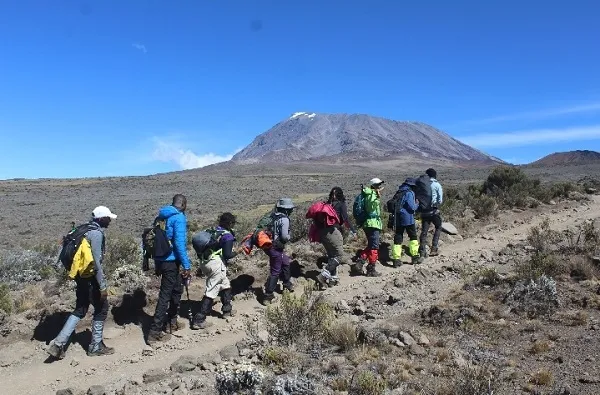
Spending two full days and nights on the Shira Plateau is one of Kilimanjaro's most extraordinary experiences. This vast, flat collapsed caldera at 3,800 m feels like standing on the roof of another planet — giant groundsels, lobelia forests, and uninterrupted 360° views of Kibo's summit cone. No other standard route spends as much time here. The plateau is the heart of the Lemosho experience.
The Lemosho Route includes the iconic 300-metre Barranco Wall scramble — the single most thrilling section of any Kilimanjaro climb. On the Lemosho, the wall arrives after days of building scenery and acclimatization, making the scramble feel like a culminating adventure. Guides are positioned throughout and assist every climber — no ropes or technical equipment required.
8-day itinerary
-
The Lemosho begins differently from every other Kilimanjaro route — a longer drive to the remote Londorossi Gate on the western slopes, entering a world of dense equatorial rainforest that very few climbers experience. The first day is intentionally gentle, allowing bodies to begin adjusting to altitude while moving through one of the most biodiverse sections of the mountain.
-
07:00Pickup from Moshi hotel
~2.5 hour drive to Londorossi Gate via Arusha direction. Longer drive than other routes — bring a book. Gear check, TANAPA registration, and porter loading before the forest entry.
-
10:30Enter the western rainforest
The Lemosho forest is the mountain's most pristine. Buffalo tracks cross the trail, colobus monkeys watch from above, and the air is thick with moisture and birdsong. An early encounter with an elephant family is not unusual. Guides brief on wildlife protocol.
-
14:00Arrive Mti Mkubwa Camp (2,750 m) — "Big Tree Camp"
Named for the enormous Podocarpus trees that tower above camp. Afternoon is free. First health monitoring check by guide. Dinner and early sleep — the days ahead build progressively.
- 📍 ~7 km
- ⏱ 4–5 hrs
- ⛰ 2,360 m → 2,750 m
- ⛺ Mti Mkubwa Camp
-
-
A transformative day — ascending through heather moorland and giant senecio forest until the trail crests the plateau rim and opens onto the Shira Plateau. The first sight of the plateau — vast, flat, ancient, with Kibo's summit cone enormous ahead — is among the most dramatic moments on any Kilimanjaro route.
-
07:30Depart Mti Mkubwa — ascend the moorland
The rainforest gives way to heather moorland. Giant lobelias appear. The air cools and thins. The trail climbs steadily toward the plateau rim.
-
12:00Plateau rim — first Shira views
Emerge from the heather onto the Shira Plateau edge. The summit is suddenly close and overwhelming. Lunch here with panoramic views. One of the great reveal moments on Kilimanjaro.
-
14:30Arrive Shira 1 Camp (3,610 m)
First camp on the plateau. Afternoon health check. Hydrate aggressively — altitude adaptation begins in earnest. If AMS symptoms appear, discuss with guide tonight.
- 📍 ~9 km
- ⏱ 6–8 hrs
- ⛰ 2,750 m → 3,610 m
- ⛺ Shira 1 Camp
-
-
A shorter, acclimatization-focused day crossing the heart of the Shira Plateau to Shira 2 Camp. The afternoon can include an optional acclimatization walk to the Shira Cathedral — a dramatic rocky outcrop at ~3,900 m with extraordinary views of the summit and across the plateau.
-
07:30Cross the plateau — Shira 1 to Shira 2
A gentle traverse across the open plateau floor. Giant groundsels tower overhead. Views of Kibo summit, Mawenzi peak, and the Shira Ridge in all directions. A genuinely otherworldly landscape.
-
11:30Arrive Shira 2 Camp (3,850 m)
Early arrival. Hot lunch in the dining tent. Rest for two hours.
-
14:00Optional: Shira Cathedral acclimatization walk
Recommended for all. Ascend to the Cathedral rocks at ~3,900 m for an hour, then return for dinner. The "climb high, sleep low" principle at work — even a modest extra gain speeds adaptation.
- 📍 ~6 km
- ⏱ 4–5 hrs
- ⛰ 3,610 m → 3,850 m
- ⛺ Shira 2 Camp
-
-
The physiologically most important day on the Lemosho Route. You ascend directly to the dramatic Lava Tower at 4,630 m — higher than Mont Blanc — for a crucial acclimatization lunch stop, then descend into the breathtaking Barranco Valley. The "climb high, sleep low" protocol is the primary mechanism behind the Lemosho's exceptional success rate.
Why the Lava Tower day maximises your summit chanceSpending time at 4,630 m stimulates your body to produce more red blood cells and adapt to the reduced oxygen — but sleeping at a lower altitude (3,960 m) prevents the fatigue that sustained high-altitude stays cause. This combination, repeated over the Lemosho's 8 days, is why the route achieves nearly 92% summit success.
-
07:30Depart Shira 2 — ascend to Lava Tower
The trail climbs through the alpine desert zone. The Lava Tower volcanic plug grows ahead. The route passes the junction with the Machame Route — you may meet other climbers here for the first time. Views become extraordinary.
-
12:30Lava Tower (4,630 m) — lunch & acclimatization
Dramatic volcanic plug at 4,630 m. Altitude effects — mild headache, reduced appetite — are normal and expected here. Rest, eat, hydrate. Do not rush. The descent ahead reverses any discomfort.
-
14:30Descend to Barranco Camp (3,960 m)
Descend into the Great Barranco Valley. Giant senecios and lobelias return. The Barranco Wall rises sheer ahead of camp — tomorrow's challenge already visible. Altitude discomfort eases with every metre of descent.
-
18:00Dinner & Barranco Wall briefing
Guide walks through tomorrow's wall ascent in detail. Questions answered. The wall is lit by the last light from camp.
- 📍 ~12 km
- ⏱ 7–9 hrs
- ⛰ 3,850 m → 4,630 m → 3,960 m
- ⛺ Barranco Camp
-
-
The highlight that every Lemosho climber talks about long after the summit. The 300-metre Barranco Wall hands-and-feet scramble is non-technical — no ropes required — but it is exposed, exhilarating, and unlike anything else on the mountain. On the Lemosho, the wall arrives after four days of building confidence and acclimatization, which makes every climber more prepared to enjoy rather than fear it.
-
06:45Cross the valley floor — face the wall
After a short valley crossing, the wall rises dramatically ahead. Guides are stationed throughout. This is a queue day — dozens of climbers from multiple routes converge here. Move steadily. No rushing.
-
07:00Begin the Barranco Wall scramble
Hands on rock, feet finding purchase. The "Kissing Rock" overhang at mid-wall requires leaning the body outward — spectacular exposure. Guides assist every step. 1.5–2 hours to the top.
-
09:00Top of the wall — panoramic summit views
Emerge on the rim. The Southern Glaciers are directly ahead. The Barranco Valley is far below. The scale of the mountain becomes clear. Brief celebration, then continue east along the Southern Circuit.
-
13:00Arrive Karanga Camp (3,995 m)
Comfortable early afternoon arrival. Last major water point — fill all bottles. Rest and hydrate completely for tomorrow's ascent to Barafu. Legs will be tired; this rest is essential.
- 📍 ~6 km
- ⏱ 5–6 hrs
- ⛰ 3,960 m → 3,995 m
- 🧗 Barranco Wall scramble
- ⛺ Karanga Camp
-
-
A short but important day. Arriving at Barafu early maximises rest before the midnight summit push. By Day 6 on the Lemosho, the body has had exceptional altitude preparation — six nights, progressive altitude gains, the Lava Tower acclimatization day. The summit push tonight is positioned from a strong physiological base.
-
07:30Depart Karanga — ascend to Barafu
Short but exposed alpine desert climb. Move deliberately and conserve energy. Do not arrive at Barafu tired. The summit push begins in 15 hours.
-
11:30Arrive Barafu Base Camp (4,673 m)
Lunch immediately. Rest completely. Do not stand in the cold unnecessarily. Eat well even if appetite is reduced. Sleep as much as possible.
-
16:30Full summit push briefing
Guide covers 23:00 wake-up, complete layering system, pace strategy, hydration plan, turn-back criteria, emergency protocols, and Stella Point vs Uhuru Peak certificates. Dinner and bed by 18:30.
- 📍 ~4 km
- ⏱ 3–4 hrs
- ⛰ 3,995 m → 4,673 m
- ⛺ Barafu Base Camp
-
-
The summit push. At midnight, by headlamp, the final ascent begins — steep scree toward Stella Point on the crater rim, then the final arc walk along the rim to Uhuru Peak at 5,895 m. For most climbers, the Lemosho summit sunrise is the most profound experience of their lives: Africa spread below, the glaciers glowing gold, seven days of effort and preparation arriving at this single, irreplaceable moment.
-
23:00Wake-up — begin summit push
Hot tea and biscuits. Final layer check — summit temperatures −10°C to −20°C. Crampons if icy. Headlamps on. The pace is deliberately slow — guide sets a sustainable rhythm. Pole pole.
-
05:30Stella Point — Crater Rim (5,745 m)
The hardest section complete. Dawn light spreading across the plateau and clouds below. Rest briefly. TANAPA certificate available here if needed. The final rim walk to Uhuru takes 45–60 minutes.
-
06:30UHURU PEAK — 5,895 m 🏔
The Roof of Africa. The wooden summit sign. Sunrise pouring across the crater glaciers. Seven days of the Lemosho's beauty and challenge delivered to this singular, unforgettable moment. Take your time here.
-
08:30Begin descent to Mweka Camp (3,100 m)
Long descent via the Mweka Route. Trekking poles essential on loose scree. Arrive Mweka Camp mid-afternoon. Celebratory dinner.
- 📍 ~19 km total
- ⏱ 12–15 hrs
- ⛰ 4,673 m → 5,895 m → 3,100 m
- ⛺ Mweka Camp
-
-
The final descent through the southern rainforest to Mweka Gate, where your official TANAPA Kilimanjaro Summit Certificate awaits. The porter farewell song at the gate — sung in Swahili by the entire crew — is one of the most moving traditions of any Kilimanjaro climb. Eight days, five ecological zones, one extraordinary summit.
-
07:30Final breakfast & porter tip ceremony
Sign the porter tip register. Say goodbye to each crew member by name. The porters matched you step for step across eight days and four ecological zones.
-
08:30Descend to Mweka Gate through the forest
3–4 hours through dense rainforest. Tired legs, full heart. Last views of Kibo through the tree canopy. Trekking poles on steep sections.
-
12:30Mweka Gate — certificate & farewell song
Your TANAPA Kilimanjaro Summit Certificate. The porter farewell song. Karibu sana — you completed Kilimanjaro's finest route. Transfer to Moshi.
-
14:00Return to Moshi — celebration
Hot shower, rest, and a well-deserved group dinner. End of all services.
- 📍 ~9 km
- ⏱ 3–4 hrs
- ⛰ 3,100 m → 1,640 m
- 🏨 Return to Moshi
-
Choose your package
All packages follow the identical 8-day Lemosho Route itinerary with tented camping throughout. The tier affects hotel comfort, guide ratio, and equipment standard.
- Budget guesthouse Moshi (Day 1 & Day 8)
- All TANAPA park & camping fees
- -certified lead guide
- All porters, cook & sleeping tents
- 3 meals/day + snacks on mountain
- Emergency supplemental oxygen
- Daily pulse oximeter monitoring
- TANAPA summit certificate
- Mid-range hotel Moshi (Day 1 & Day 8)
- All TANAPA park & camping fees
- Dedicated lead guide + assistant guide
- All porters, cook, waiter & toilet tent
- 3 meals/day + hot drinks + snacks
- Safety oxygen + Gamow bag
- Twice-daily oximeter check
- Airport transfers included
- TANAPA summit certificate
- Boutique hotel Moshi (Day 1 & Day 8)
- All TANAPA park & camping fees
- Private 1:1 guide ratio
- Full crew + private toilet + shower tent
- Restaurant-quality meals + full snack bar
- Oxygen, Gamow bag & AED device
- 3× daily oximeter + satellite communicator
- Airport transfers + Moshi cultural tour
- Safari combo pricing available
What's included
- All TANAPA national park entry fees
- Camping fees for all 7 nights on the mountain
- -certified professional lead guide
- Assistant guide (1 per 3 climbers)
- Porters (~3 per climber) + mountain cook
- High-quality dome sleeping tents + dining tent
- All mountain meals (3 per day) + water
- Emergency supplemental oxygen cylinder
- Daily pulse oximeter health monitoring
- TANAPA summit certificate at Mweka Gate
- KINAPA rescue fee contribution
- International flights to KIA / JRO airport
- Tanzania tourist visa (~$50 USD)
- Personal travel & evacuation insurance
- Personal hiking gear (rental available in Moshi)
- Sleeping bag −15°C rated (rental available)
- Trekking poles — strongly recommended (rental available)
- Tips / gratuities for guides and porters
- Alcoholic beverages
- Diamox altitude medication (prescription required)
How Lemosho compares to other routes
The Lemosho Route in context — note the industry-leading summit success rate versus all other standard itineraries:
| Route | Days | Sleeping | Success | Difficulty | Crowds | From |
|---|---|---|---|---|---|---|
| Marangu 6-day | 6 | Huts 🏠 | ~80% | Moderate | High | $1,850 |
| Machame 7-day | 7 | Tents ⛺ | ~85% | Challenging | High | $1,900 |
| Umbwe 7-day | 7 | Tents ⛺ | ~70–75% | Hardest | Very low | $1,950 |
| Rongai 7-day | 7 | Tents + Huts | ~85% | Moderate | Low | $2,100 |
| Lemosho 8-day ← You are here | 8 | Tents ⛺ | ~88–92% | Challenging | Moderate | $2,050 |
Essential gear checklist
Kilimanjaro requires clothing for tropical rainforest (warm & wet) through to arctic summit conditions (−20°C). The layering system is everything.
| Category | Items | Status |
|---|---|---|
| Footwear | Waterproof hiking boots (broken in), camp sandals, gaiters, wool socks ×5 | Essential |
| Base layers | Moisture-wicking thermal top & bottom ×2, lightweight long-sleeve shirts ×3 | Essential |
| Insulation | Down jacket or heavy synthetic jacket (−15°C rated), fleece mid-layer | Essential |
| Shell | Waterproof/windproof jacket & trousers (Gore-Tex or equivalent) | Essential |
| Extremities | Warm hat (wool/fleece), sun hat, balaclava, liner gloves, summit mitts | Essential |
| Trekking poles | 2× adjustable trekking poles (rentals available from Resilience Expeditions) | Strongly rec. |
| Daypack | 20–30L daypack (porters carry main bag) | Essential |
| Sleeping bag | −15°C rated (4-season) sleeping bag (rentals available) | Essential |
| Hydration | 2× 1L water bottles or 3L hydration bladder, water purification tablets | Essential |
| Sun protection | SPF 50+ sunscreen, UV-blocking sunglasses, lip balm SPF | Essential |
| Headlamp | Bright headlamp + 2× spare batteries (summit night is in total darkness) | Essential |
| Other | Blister treatment, altitude sickness medication (Diamox — prescr.), camera | Recommended |
Best time to climb
The Lemosho's western approach through dense rainforest can be muddy in wet months, but the route is climbable year-round with the right expectations:
| Months | Season | Summit | Lemosho Forest Trail | Crowds |
|---|---|---|---|---|
| Jan – Feb | Dry & cold | Excellent | Firm, clear forest paths | Low |
| Mar – May | Long rains | Possible | Muddy — waterproof gear essential | Minimal |
| Jun – Oct | Dry (peak) | Excellent | Dry, firm, ideal conditions | Moderate–High |
| Nov | Short rains | Good | Some mud — manageable | Low |
| Dec | Dry & clear | Excellent | Dry, firm, quiet | Low |
Unlike the Umbwe Route, the Lemosho is viable in all months — the wetter months simply require waterproof gear and lower expectations for dry trail conditions. The western rainforest section becomes muddy but remains passable. For the best overall experience, we recommend January–February or June–October.
Frequently asked questions
-
The Lemosho Route is widely considered Kilimanjaro's finest all-round route. It achieves the highest summit success rate (~88–92% on 8 days), passes through the most ecologically diverse terrain on the mountain (from western rainforest through the Shira Plateau to the Southern Circuit), and offers a gradual acclimatization profile that suits both first-time high-altitude trekkers and experienced mountaineers. The extra day compared to the 7-day Machame makes a significant difference to summit success rate and overall experience quality.
-
No — the Lemosho Route is suitable for fit, healthy adults with no prior high-altitude experience. The 8-day itinerary provides enough time and a gradual enough ascent profile that most climbers with good cardiovascular fitness can acclimatize successfully. We do recommend regular aerobic exercise in the months before your climb (hiking, running, cycling) and staying well-hydrated on the mountain. We do not recommend the Lemosho for anyone with untreated heart, lung, or blood conditions — speak to a doctor before booking.
-
Prices range from $2,050 (standard group) to $3,000 (private luxury) per person. All packages include all TANAPA park fees, camping fees for 7 nights, tents, all mountain meals-certified guides and porters, emergency oxygen, and the TANAPA summit certificate. International flights and visa are not included. Compared to the Machame or Rongai routes, the Lemosho costs slightly more due to the extra day's park fees, camping fees, and crew costs.
-
Yes — the Barranco Wall is included on Day 5 of the Lemosho itinerary and is consistently rated the single most memorable section of the entire climb. The 300-metre hands-and-feet rock scramble is non-technical (no ropes required), and guides assist every climber throughout. The Lemosho's approach to the wall — arriving from the Lava Tower direction after crossing the Shira Plateau — is particularly dramatic, with the wall visible across the Barranco Valley as you descend from 4,630 m.
-
The Machame and Lemosho routes join at the Shira Plateau and share the same trail from Shira 2 Camp through the Barranco Wall, Karanga, Barafu, and the summit. The key differences are: the Lemosho has a remote, uncrowded western approach through pristine rainforest that the Machame does not; the Lemosho adds two full days on the Shira Plateau for superior acclimatization; the Lemosho is 8 days vs the Machame's 7; and the Lemosho achieves a higher summit success rate (~92% vs ~85%). For most climbers willing to spend the extra day, the Lemosho is worth it.
-
Yes, without exception. Resilience Expeditions is a registered (Kilimanjaro Porters Assistance Project) partner. All porters receive wages above the fair wage standard, are never loaded beyond TANAPA's 20 kg limit, receive appropriate cold-weather clothing and equipment, are covered by health and accident insurance, and receive sufficient food. Porter welfare is non-negotiable on every climb we run.


