
About this climb
The 7-day Rongai Route is the finest way to experience Kilimanjaro's only northern approach — and our recommended Rongai itinerary for the vast majority of climbers. By adding a single extra overnight at Kikelewa Camp (3,670 m), the 7-day gives your body a crucial additional night to adapt to altitude before ascending to School Hut (4,750 m) and the summit push.
Beyond the improved acclimatization, the extra day brings another significant benefit: more time in the extraordinary northern forest. The 7-day's more relaxed pace through Days 1–3 gives climbers much greater opportunity for wildlife encounters, photography, and the kind of unhurried appreciation of the remote northern landscape that makes the Rongai so special. Descent is via the Marangu Route, giving every Rongai climber two completely different sides of Kilimanjaro in one expedition.
Kikelewa Camp sits at 3,670 m — a moderate altitude that provides meaningful physiological benefit without being debilitating. Spending an extra night here allows your kidneys to produce more erythropoietin (EPO), stimulating red blood cell production. The result is measurably improved oxygen-carrying capacity by the time you reach School Hut and begin the summit push. One night, ~5 percentage points more summit success.
The 7-day's more relaxed Days 1–3 pace means significantly more time in the northern forest and lower moorland — the prime wildlife zone. Elephants, buffalo, colobus monkeys, and birds are far more likely to be encountered when you're moving slowly and quietly rather than pressing through at pace. Bring binoculars and a good camera.
Every Rongai climber ascends via the northern approach from near the Kenya border and descends via the Marangu Route on the south-east side. The contrast is remarkable — dry, open, dramatic northern slopes on the way up; lush, green, misty southern forest on the way down. Very few Kilimanjaro experiences match this breadth of perspective.
Wildlife on the Rongai Route
The remote northern forest sees very few visitors. The 7-day's relaxed pace through the lower sections dramatically increases encounter opportunities with Kilimanjaro's remarkable wildlife.
7-day itinerary
-
A long drive from Moshi (approximately 3.5 hours) delivers you to the remote Rongai Gate near Loitokitok, close to the Kenyan border. The forest entry is immediate and quiet — a dramatic contrast to the busy southern route gates. Elephant and buffalo encounters are possible from the first steps into the forest.
-
06:30Depart Moshi for Rongai Gate
~3.5 hour drive north toward the Kenya border through Kilimanjaro's northern foothills. The mountain's rarely-seen northern face becomes increasingly visible.
-
10:30Rongai Gate (2,000 m) — register and enter
Park entry registration at the remote gate. Armed ranger joins the group. Enter the northern forest — stay alert and quiet for wildlife. Move at an unhurried pace.
-
13:00Hot lunch in the forest
Break in the forest as porters continue ahead. Very peaceful — no other groups in this section.
-
15:30Arrive Simba Camp (2,640 m)
First camp in open heather moorland. Wide views north toward Kenya and the Amboseli plains on clear days. Dinner, hot drinks, and first oxygen saturation check.
- 📍 ~9 km
- ⏱ 3–4 hrs hiking
- ⛰ 2,000 m → 2,640 m
- ⛺ Simba Camp
-
-
A gradual, rewarding ascent through the northern moorland toward Second Cave. The "Caves" are large lava overhangs — not actual caves — that provided shelter for early expeditions. Today's shorter hiking day (compared to the 6-day equivalent) gives maximum time for wildlife observation and photography.
-
07:00Depart Simba Camp
Climb through open heather moorland. Northern face of Kilimanjaro directly ahead. Wide views to Kenya behind you. Watch for elephant and buffalo at the forest margins.
-
11:00Arrive Second Cave Camp (3,450 m)
Camp beside the distinctive lava overhangs. Arrive early — the 7-day's more relaxed pace provides a long afternoon at this camp for acclimatization walks, wildlife watching, and rest.
-
14:00Optional acclimatization hike
Optional guided walk above 3,600 m for "climb high, sleep low" benefit, returning to Second Cave for the night. Your guide checks oxygen saturation readings for all climbers.
- 📍 ~9 km
- ⏱ 4–5 hrs
- ⛰ 2,640 m → 3,450 m
- ⛺ Second Cave Camp
-
-
This is the day that distinguishes the 7-day Rongai from the 6-day — and the single biggest reason for its higher summit success rate. A short, relaxed hike to Kikelewa Camp (3,670 m) gives your body a full extra night at altitude to physiologically adapt before the significant ascent to School Hut the following day. The afternoon is completely free for rest, wildlife observation, and quiet appreciation of the remarkable landscape.
The science behind this dayAt 3,670 m, atmospheric oxygen is approximately 65% of sea-level values. Your kidneys respond by secreting erythropoietin (EPO), which stimulates increased red blood cell production over the next 24–72 hours. This additional night at Kikelewa gives your body measurably more time to begin this process before you face the demanding ascent to School Hut (4,750 m) the next morning.
-
08:00Leisurely departure from Second Cave
Short hiking day — no need to rush. Take time to absorb the landscape and watch for late-morning wildlife before ascending.
-
11:30Arrive Kikelewa Camp (3,670 m)
Arrive well before noon. Lunch, then a completely free afternoon. Rest, read, hydrate aggressively, and allow your body to work at altitude.
-
14:00Optional short acclimatization hike
Optional guided walk to ~3,900 m and return to Kikelewa — the classic "climb high, sleep low" principle applied once more. Enhances physiological adaptation further.
-
18:00Dinner & altitude briefing
Guide conducts oxygen saturation monitoring for all climbers and briefs the team on what to expect tomorrow's longer ascent to School Hut at 4,750 m.
- 📍 ~4 km
- ⏱ 2–3 hrs hiking
- ⛰ 3,450 m → 3,670 m
- 📈 Extra acclimatization
- ⛺ Kikelewa Camp
-
-
A significant altitude day — passing through Third Cave and ascending into the stark alpine desert to School Hut (Kibo North Camp) at 4,750 m. School Hut is the highest regular campsite on the Rongai Route, perched on the north-east flank of Kibo with extraordinary views of Mawenzi peak and the Kenyan plains far below. Every step today has been made easier by last night's extra acclimatization.
-
07:00Depart Kikelewa — pass Third Cave
Ascend through the upper moorland past Third Cave Camp. Vegetation thins rapidly as you enter the alpine desert zone. The northern face of Kibo dominates the view ahead.
-
11:00Last water point (4,200 m)
Fill all bottles completely — no water source from here to Horombo Hut on the descent (3,720 m). A full 3–4 litres per person minimum.
-
14:00Arrive School Hut (4,750 m)
The highest campsite on the Rongai Route. Lunch immediately on arrival. Extraordinary views of Mawenzi peak and the east. Rest completely. No exertion this afternoon.
-
17:00Full summit night briefing & early dinner
Guide covers the complete summit push: midnight wake-up, layering system, pace, hydration, turn-back criteria, and emergency protocols. Bed by 18:30.
- 📍 ~9 km
- ⏱ 5–7 hrs
- ⛰ 3,670 m → 4,750 m
- ⛺ School Hut
-
-
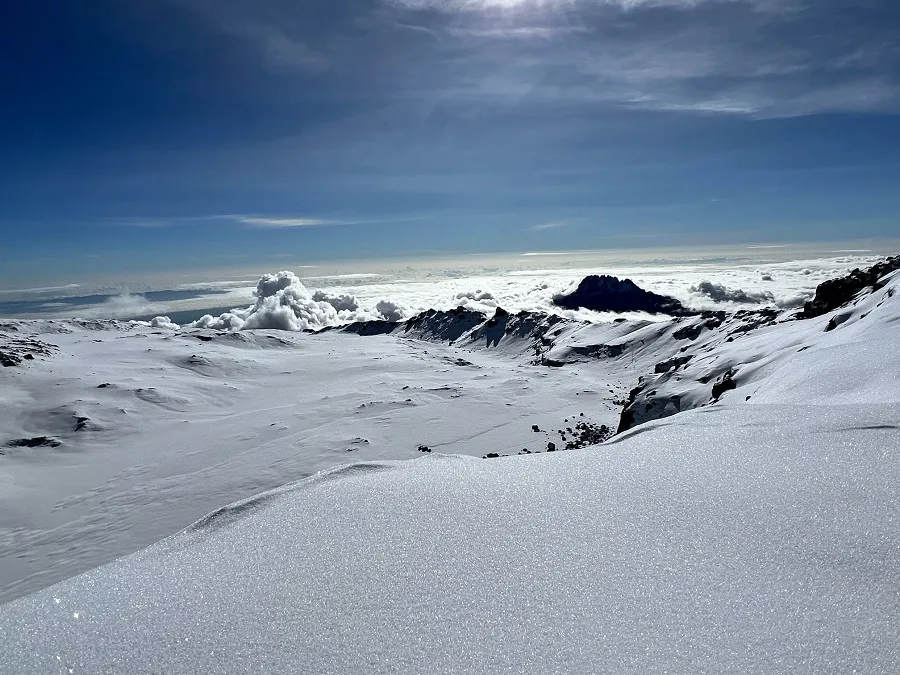
Everything builds to this night. The Rongai summit push is unique — approaching Gilman's Point from the north-east, with a perspective on the crater rim and summit that differs from all southern routes. The view back over the Kenyan plains at sunrise from Uhuru Peak is seen by very few Kilimanjaro climbers. A long, triumphant descent to Horombo Hut follows.
-
23:00Wake up — begin summit push
Hot tea, biscuits, final layer system check. Temperature −10°C to −22°C near summit. School Hut's higher starting point (4,750 m) means a slightly shorter ascent to the crater rim than on the Machame. Headlamps on. Pole pole.
-
04:30Gilman's Point — Crater Rim (5,681 m)
First light on the horizon. The entire expanse of north-eastern Kenya spreads below. Brief rest, then the final arc walk along the crater rim to Uhuru Peak.
-
06:00UHURU PEAK — 5,895 m 🏔
The Roof of Africa. Sunrise. The Kenya plains stretch to the horizon. The summit views from the north are unique — only Rongai climbers see this particular perspective. Your guide photographs you. Absorb the moment entirely.
-
08:00Descent via Marangu Route → Horombo Hut
Begin descending the southern face — your first experience of the south side. A long but triumphant descent to Horombo Hut at 3,720 m.
- 📍 ~17 km total
- ⏱ 12–15 hrs
- ⛰ 4,750 m → 5,895 m → 3,720 m
- 🏠 Horombo Hut
-
-
The descent via the Marangu Route is one of the most rewarding aspects of the Rongai experience — entering the lush, misty southern forest for the first time after days on the dry, open northern slopes. The contrast is striking and makes for a deeply satisfying final chapter to the expedition.
-
07:30Breakfast at Horombo & depart
Leisurely morning. The summit is behind you. Descend through the Marangu moorland zone — softer, greener, and wetter than anything on the northern ascent.
-
11:00Enter the southern rainforest
Descend into the Podocarpus forest — lush, fragrant, and noticeably more verdant than the northern forest. Colobus monkeys, forest birds, and giant ferns all around.
-
13:30Arrive Mandara Hut (2,720 m)
Final overnight in the forest. Lunch, optional Maundi Crater viewpoint walk (30 minutes), and a relaxed afternoon reflecting on the journey.
- 📍 ~12 km
- ⏱ 4–5 hrs
- ⛰ 3,720 m → 2,720 m
- 🏠 Mandara Hut
-
-
The final descent through the forest to Marangu Gate, where your official TANAPA summit certificate awaits. The porters' farewell song at the gate brings many climbers to tears — a genuine, spontaneous expression of shared achievement that marks the true end of every Kilimanjaro expedition.
-
07:30Final breakfast & porter goodbyes
Unhurried last morning at Mandara Hut. Sign the porter tip register. Say goodbye to each crew member individually — they made every step possible.
-
08:30Descend to Marangu Gate through forest
2–3 hour walk through the southern rainforest. Easy terrain — a gentle and beautiful ending to seven extraordinary days on the mountain.
-
11:30Marangu Gate — certificate presentation
Official TANAPA Kilimanjaro Summit Certificate presented. Porters and guides perform the farewell song. Karibu sana — you climbed Africa from the north.
-
13:00Return to Moshi — celebration
Hot shower, rest, and a group celebration dinner. End of all services.
- 📍 ~8 km
- ⏱ 2–3 hrs
- ⛰ 2,720 m → 1,870 m
- 🏨 Return to Moshi
-
Choose your package
All packages follow the identical 7-day Rongai Route itinerary. The tier affects hotel comfort, guide ratio, and included extras.
- Budget guesthouse Moshi (Day 1 & Day 7)
- All TANAPA park, camping & hut fees
- -certified lead guide + armed ranger
- All porters & mountain cook
- 3 meals/day + snacks on mountain
- Emergency supplemental oxygen
- Daily pulse oximeter monitoring
- TANAPA summit certificate
- Mid-range hotel Moshi (Day 1 & Day 7)
- All TANAPA park, camping & hut fees
- Dedicated lead guide + assistant + armed ranger
- All porters, cook, waiter & toilet tent
- 3 meals/day + hot drinks + snacks
- Safety oxygen + Gamow bag
- Twice-daily oximeter check
- Airport transfers included
- TANAPA summit certificate
- Boutique hotel Moshi (Day 1 & Day 7)
- All TANAPA park, camping & hut fees
- Private 1:1 guide ratio + armed ranger
- Full crew + private toilet + shower tent
- Restaurant-quality meals + full snack bar
- Oxygen, Gamow bag & AED device
- 3× daily oximeter + satellite communicator
- Airport transfers + Moshi cultural tour
- Safari combo pricing available
What's included
- All TANAPA national park entry fees
- Camping fees (4 nights tented on ascent) + hut fees (2 nights Marangu descent)
- -certified professional lead guide
- Armed ranger for the northern forest zone
- Assistant guide (1 per 3 climbers)
- Porters (~3 per climber) + mountain cook
- All mountain meals (3 per day) + water
- Emergency supplemental oxygen cylinder
- Daily pulse oximeter health monitoring
- TANAPA summit certificate at Marangu Gate
- KINAPA rescue fee contribution
- International flights to KIA / JRO airport
- Tanzania tourist visa (~$50 USD)
- Personal travel & evacuation insurance
- Personal hiking gear (rental available in Moshi)
- Sleeping bag −15°C rated (rental available)
- Trekking poles (recommended, rental available)
- Tips / gratuities for guides and porters
- Alcoholic beverages
- Diamox altitude medication (prescription required)
How the 7-day Rongai compares
Where this itinerary sits among all Kilimanjaro options:
| Route | Days | Sleeping | Success | Direction | Difficulty | From |
|---|---|---|---|---|---|---|
| Rongai 6-day | 6 | Tents + Huts | ~80% | North | Moderate | $1,950 |
| Rongai 7-day ← You are here | 7 | Tents + Huts | ~85% | North ← only! | Moderate | $2,100 |
| Machame 7-day | 7 | Tents ⛺ | ~85% | South | Challenging | $1,900 |
| Marangu 6-day | 6 | Huts 🏠 | ~80% | South-east | Moderate | $1,850 |
| Lemosho 8-day | 8 | Tents ⛺ | ~92% | West | Challenging | $2,200 |
Best time to climb
The Rongai's northern exposure makes it drier year-round than any southern route:
| Months | Season | Summit | Northern Trail | Wildlife |
|---|---|---|---|---|
| Jan – Feb | Dry & clear | Excellent | Dry, firm grip | High |
| Mar – May | Long rains | Acceptable | Drier than south | Very high 🐘 |
| Jun – Oct | Dry (peak) | Excellent | Dry, clear, firm | High |
| Nov | Short rains | Acceptable | Some rain, manageable | Very high 🐘 |
| Dec | Dry & cold | Excellent | Dry, firm, clear | High |
The Rongai's northern exposure means significantly less rainfall during the long rains (March–May) compared to southern routes. Wildlife sightings are actually highest during the wet season when fewer humans are on the trail. If wildlife observation is your priority, March–May and November are exceptional.
Frequently asked questions
-
The 7-day Rongai Route adds an extra overnight at Kikelewa Camp (3,670 m), which sits between Second Cave and Third Cave on the 6-day route. This extra night at a moderate altitude gives your body an additional 24 hours of physiological adaptation before the major ascent to School Hut (4,750 m) and the summit push. The result is a summit success rate improvement from approximately 80% to approximately 85%, a more relaxed pace through the wildlife zone on Days 1–3, and a more enjoyable overall experience on the mountain.
-
Prices range from $2,100 (standard group) to $2,900 (private luxury) per person. All packages include all TANAPA park fees, camping fees for 4 nights, hut accommodation for 2 descent nights, an armed ranger for the wildlife zone, all meals-certified guides and porters, emergency oxygen, and the TANAPA summit certificate. International flights and visa are separate.
-
For most climbers, yes — the 7-day is our recommended Rongai itinerary. The extra overnight at Kikelewa costs approximately $150 more per person and one additional day of leave, but delivers meaningfully better acclimatization, a higher summit success rate (~85% vs ~80%), more time in the wildlife zone, and a more relaxed and enjoyable overall experience. We recommend the 7-day to any climber who has the schedule flexibility for it.
-
The Rongai Route is fundamentally different from all other Kilimanjaro routes because it approaches from the north, near the Kenya border. Every other route — Machame, Marangu, Lemosho, Umbwe — approaches from the south or east. This gives Rongai climbers: significantly drier conditions year-round, a completely different landscape and flora, Kilimanjaro's best wildlife zone (elephants are regularly encountered), views of the rarely-photographed northern face, far fewer climbers on the trail (the quietest route on the mountain), and a descent via the Marangu Route giving two entirely different sides of the mountain in one climb. Additionally, the Rongai lacks the Barranco Wall found on Machame, making it a more moderate route technically — closer to the Marangu Route in terms of difficulty but using tented camping.
-
Yes — the Rongai Route is a very good choice for first-time Kilimanjaro climbers, particularly those who value wildlife and a remote experience over the high-traffic routes. The terrain is more moderate than Machame (no Barranco Wall), the gradients are gentle, and the 7-day itinerary's acclimatization profile is solid. First-time climbers with good cardiovascular fitness and some hiking experience are well-suited to this route.
-
Yes, without exception. Resilience Expedition is a registered (Kilimanjaro Porters Assistance Project) partner. All porters receive wages above the fair wage standard, are never loaded beyond TANAPA's 20 kg limit, receive appropriate clothing and equipment for every climb, are covered by health and accident insurance, and receive sufficient food throughout. Porter welfare is non-negotiable on every climb we run.


