Medical information notice: This article is written by experienced Kilimanjaro guides for educational purposes. It is not a substitute for professional medical advice. Consult a doctor — ideally a travel medicine specialist — before climbing Kilimanjaro. If you are on the mountain and experiencing serious symptoms, follow your guide's instructions without delay.
What is altitude sickness?
Altitude sickness is the body's response to reduced atmospheric oxygen at high elevation. At sea level, the air contains approximately 21% oxygen at a pressure that allows efficient breathing. At 5,895 m — Kilimanjaro's summit — atmospheric pressure is roughly half of sea level, which means each breath delivers only half as much oxygen to your lungs. Your body responds by breathing faster, increasing heart rate, and over several days producing more red blood cells — a process called acclimatisation.
When ascent happens too quickly for this adaptation to occur, the result is altitude sickness — a spectrum of conditions ranging from mild headache and fatigue (Acute Mountain Sickness, or AMS) to life-threatening brain swelling (High Altitude Cerebral Edema, HACE) and fluid in the lungs (High Altitude Pulmonary Edema, HAPE). The critical insight is that these conditions exist on a spectrum: mild AMS can progress to HACE or HAPE if ascent continues and symptoms are ignored.
One of the most dangerous misconceptions about altitude sickness is that fit people don't get it. Fitness determines how fast you can hike — it does not determine how well your body acclimatises. Marathon runners, professional athletes, and experienced mountaineers develop severe altitude sickness on Kilimanjaro. The only reliable predictors of acclimatisation are your genetic predisposition (which cannot be tested in advance), your ascent rate, and how many nights you spend above 3,000 m. Training for Kilimanjaro is important — but no amount of training prevents altitude sickness.
Altitude and oxygen on Kilimanjaro
Understanding the oxygen profile of the climb helps explain why certain camps are where most altitude problems develop. The critical zone — where acclimatisation struggles most — is above 4,000 m.
Oxygen availability by camp altitude
Approximate blood oxygen saturation (SpO2) for a well-acclimatised climber at each camp
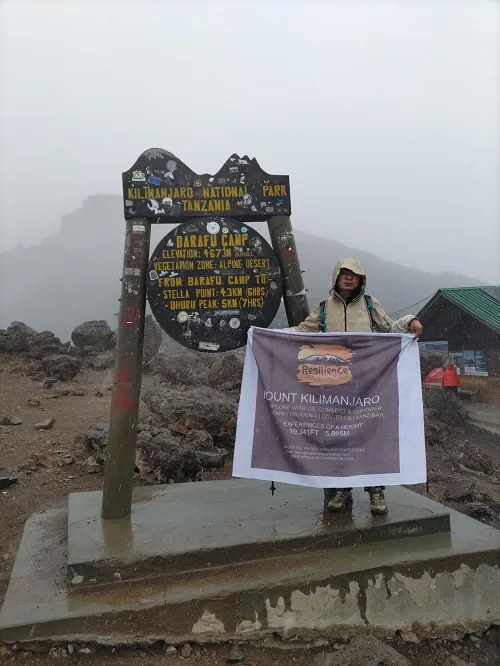
The sharp drop from Barafu High Camp (4,673 m) to Uhuru Peak (5,895 m) on summit night — a 1,200 m vertical gain over 5–6 hours — is where most altitude emergencies occur. Your body's acclimatisation to Barafu is not transferable to the summit; the final ascent happens faster than your physiology can adapt. This is why every summit push is monitored by your guide with a pulse oximeter.
AMS, HACE & HAPE — the severity spectrum
Altitude illness exists on a continuous spectrum from mild inconvenience to medical emergency. Understanding where you are on this spectrum is the most important skill a climber can have.
Symptoms: Headache (the defining symptom — must be present), mild fatigue, loss of appetite, mild nausea, slight dizziness, difficulty sleeping. Symptoms typically appear 6–12 hours after reaching a new altitude and are worse at night.
✓ Rest at same altitude — do not ascend furtherSymptoms: Persistent headache unresponsive to ibuprofen/paracetamol, moderate nausea or vomiting, significant fatigue, reduced urine output, noticeable SpO2 drop, breathlessness on mild exertion, difficulty concentrating.
⬇ Descend 300–500 m if no improvement within 24 hoursSymptoms: Severe, incapacitating headache, repeated vomiting, extreme fatigue and weakness, marked breathlessness at rest, reduced coordination, inability to perform simple tasks, severe SpO2 reduction.
⬇ Descend immediately — do not wait overnightSymptoms: Confusion, altered mental state, extreme drowsiness, loss of coordination (ataxia — cannot walk heel-to-toe in a straight line), severe headache, loss of consciousness. HACE is severe AMS with neurological involvement — it can develop rapidly from moderate AMS.
🚨 EMERGENCY — Descend immediately + supplemental oxygenSymptoms: Breathlessness at rest (not just on exertion), persistent dry cough progressing to pink/frothy sputum, extreme fatigue, bluish lips or fingertips (cyanosis), crackling sound in the chest, rapid and irregular heartbeat. HAPE can be present without headache — do not wait for headache to develop.
🚨 EMERGENCY — Descend immediately + oxygen — can be fatal within hoursBoth HACE and HAPE can progress to death within hours if not treated with immediate descent. On Kilimanjaro, descent of even 300–500 m provides significant relief. If your guide tells you to descend, descend — without debate, without delay. The climb can be attempted again. There is no scenario in which completing a summit is worth a climber's life. All Resilience Expedition guides are trained to recognise and respond to HACE and HAPE and are authorised to order immediate descent.
Recognising HACE and HAPE
Both conditions require immediate recognition and action. The key distinguishing feature of HACE is neurological change (confusion, coordination loss). The key feature of HAPE is breathlessness at rest. Either can be present without the other.
HACE — High Altitude Cerebral Edema
Brain swelling due to fluid accumulation at altitude
Recognise it by:
- Confusion, disorientation, unusual behaviour
- Cannot walk heel-to-toe in a straight line (ataxia test)
- Extreme drowsiness — difficulty staying awake
- Severe, incapacitating headache
- Loss of consciousness (late stage)
- Slurred speech, double vision
The ataxia test:
Ask the climber to walk a straight line heel-to-toe for 10 paces. A healthy person can do this easily. A climber with HACE will stagger, need to use their arms for balance, or fall. This is one of the most reliable early HACE indicators — test every climber at High Camp if concerned.
⬇ See descent decision frameworkHAPE — High Altitude Pulmonary Edema
Fluid accumulation in the lungs at altitude
Recognise it by:
- Breathlessness at rest — not just when moving
- Persistent, worsening dry cough
- Pink, frothy, or blood-tinged sputum (late stage)
- Blue or grey lips and fingertips (cyanosis)
- Crackling or gurgling sounds in the chest
- Extreme exhaustion disproportionate to exertion
- SpO2 significantly lower than other group members
⚠ HAPE can occur without AMS headache. Do not wait for a headache to develop before acting.
⬇ See descent decision frameworkAssess your symptoms: Lake Louise Score
The Lake Louise Score (LLS) is the internationally recognised tool for assessing AMS severity. Our guides use it at every camp check-in above 3,500 m. Use this to understand your own symptom level — but always tell your guide everything you are feeling, regardless of your score.
Lake Louise Score — AMS Assessment
Answer 5 questions about your current symptoms. Results appear immediately. A score of 3+ with headache = AMS. 6+ = moderate-to-severe.
Note: The Lake Louise Score requires headache to be present for an AMS diagnosis. A score of 3+ with headache = AMS. A score of 6+ = moderate-to-severe AMS. These thresholds are clinical guidelines — always tell your guide your complete symptom picture regardless of score.
SpO2 readings — what the numbers mean
Your guide takes pulse oximeter (SpO2) readings at every camp check-in. SpO2 measures the oxygen saturation of your blood — what percentage of your red blood cells are carrying oxygen. The absolute number matters less than the trend and your comparison to other group members at the same altitude.
Some climbers naturally maintain lower SpO2 without symptoms; others develop severe altitude illness at readings that appear acceptable. Your symptoms, the trajectory of your readings, and how your numbers compare to other group members at the same altitude are all relevant inputs. A climber with SpO2 of 85% who feels well and is maintaining altitude in a group where 85% is normal for that camp is different from a climber at 85% whose reading was 94% the previous evening. Context matters — your guide integrates all of this information.
Prevention: what actually works
The good news about altitude sickness prevention is that the most effective interventions are behavioural, not pharmaceutical — and they are fully within your control before and during the climb.
| Prevention method | Effectiveness | Notes |
|---|---|---|
| Choose a longer route (7–8 days) | Very high | Most impactful single decision. Each extra day above 3,000 m improves acclimatisation significantly. |
| Climb high, sleep low | Very high | Naturally built into well-designed routes (Lemosho, Machame). Ascending during the day and descending to sleep allows acclimatisation without time cost. |
| Pace yourself — "pole pole" | High | Pole pole (Swahili for "slowly slowly") is the Kilimanjaro guide's mantra. Moving slowly reduces exertion and allows your body more time at each altitude band. Faster is never better above 3,000 m. |
| Hydration (3–4 litres/day) | Moderate | Dehydration worsens AMS symptoms significantly. Drink consistently throughout the day, not in large quantities at once. Clear urine = adequate hydration. |
| Acetazolamide (Diamox) | Moderate | Prescription medication. Reduces AMS frequency and severity. Does not eliminate AMS. See Diamox section below for full guidance. |
| Pre-trip altitude exposure | Moderate | Spending nights above 2,500–3,000 m in the weeks before your climb (e.g. Mount Meru, alpine trekking) provides meaningful pre-acclimatisation benefit. |
| Avoid alcohol and sedatives | Moderate | Both suppress breathing during sleep, worsening nocturnal hypoxia. Avoid above 3,000 m. No alcohol above 3,500 m under any circumstances. |
| Fitness training | Indirect | Fitness does not improve acclimatisation directly but allows you to climb more slowly without cardiovascular distress — which reduces exertion-driven hypoxia. |
| Ibuprofen prophylaxis | Low | Some evidence suggests 400mg ibuprofen 3× daily reduces AMS headache incidence. Not a primary prevention strategy — ensure adequate hydration to protect kidneys. |
Diamox (Acetazolamide) — complete guidance
Acetazolamide, sold as Diamox, is a carbonic anhydrase inhibitor that works by acidifying the blood, which stimulates increased breathing rate (respiratory drive) and improves oxygenation at altitude. It is the only drug with solid clinical evidence for AMS prevention and is commonly prescribed for Kilimanjaro climbers.
How to take it
The standard preventive dose is 125–250mg twice daily, starting 24–48 hours before ascent above 2,500 m and continuing until you have been at your target altitude for two days or are descending. Some climbers prefer the lower 125mg dose to minimise side effects while maintaining prevention benefit — discuss with your doctor. Diamox is also used as treatment for AMS at 250mg twice daily.
Diamox is a sulphonamide-class drug and should not be taken by people with sulpha drug allergies (including some patients sensitive to Septrin/co-trimoxazole), penicillin allergies (possible cross-reactivity), or certain kidney conditions. Always consult a doctor before taking it. Take a test dose at home — at least two weeks before travel — to check for unusual side effects before you are on the mountain.
Common and expected side effects
The vast majority of people taking Diamox experience tingling in the fingers, toes, and lips — this is completely normal and does not require stopping the drug. Increased urination is also expected (Diamox is a mild diuretic — stay hydrated). Carbonated drinks taste flat or metallic. These effects resolve quickly after stopping the drug. Less common effects include fatigue, blurred vision, and sun sensitivity.
A common concern is that Diamox "masks" altitude sickness symptoms, allowing climbers to continue when they should stop. This is a misconception. Diamox works by genuinely improving your acclimatisation physiology — it is not a painkiller or a suppressor of symptoms. It cannot hide the hallmark signs of HACE (ataxia, confusion) or HAPE (breathlessness at rest). Your guide's SpO2 monitoring and symptom checks remain the primary safety system regardless of Diamox use.
The descent decision — when to go down
The most life-saving decision on Kilimanjaro is not the one to continue — it is the one to descend. Every altitude death on the mountain involves a delay in descent after warning signs were present. The framework below is what our guides use. It has one underlying principle: when in doubt, descend.
The descent decision framework
Our guides apply this sequence at every camp check-in and whenever a climber shows symptoms. It takes approximately 60 seconds. The output is always one of three decisions.
How Resilience Expedition guides monitor altitude health
Our guides are -certified and trained in Wilderness First Response. Every guide carries a pulse oximeter and supplemental oxygen on every climb. This section explains our standard protocol — so you know what to expect and why it matters.
The most dangerous thing a climber can do on Kilimanjaro is hide symptoms from their guide. Pride, the fear of "ruining" the group's summit attempt, or the desire to appear tough all contribute to underreporting — which turns manageable AMS into emergency situations. Your guide is not going to send you down for a mild headache. They need complete information to make safe decisions. Tell them everything.
Common myths about altitude sickness
Myth: "If I've been to altitude before, I'll be fine."
Your acclimatisation on a previous climb does not transfer to your next climb. Each time you ascend to altitude, your body must acclimatise again from scratch. Previous successful Kilimanjaro summits do not reduce your risk on a subsequent attempt — though experience in reading and reporting your own symptoms is valuable.
Myth: "Drinking lots of water prevents altitude sickness."
Hydration is important on Kilimanjaro and dehydration genuinely worsens AMS symptoms. However, overhydration can also cause problems — hyponatraemia (low blood sodium from excessive water intake) shares some symptoms with AMS and can be dangerous. Drink 3–4 litres per day, consistently, with electrolytes where possible. Drink to thirst, aiming for pale yellow urine.
Myth: "Garlic, ginger, and supplements prevent altitude sickness."
There is no credible clinical evidence that garlic, ginger, coca leaves, Ginko biloba, or similar supplements meaningfully prevent AMS. Some small studies suggest Ginko biloba may have minor effects, but the evidence is inconsistent and the effect size small compared to route selection or Diamox. Save your supplement budget for proper gear.
Myth: "I can push through it."
You cannot push through HACE or HAPE. The human will is remarkable in many situations — altitude illness is not one of them. HACE and HAPE are caused by fluid accumulation in the brain and lungs respectively, and no amount of determination reverses this. Continuing to ascend with these conditions is not resilience — it is a mechanism for a fatal outcome. The mountain will be there next year. Your body will not recover from a summit-night HAPE death.
More Kilimanjaro guides