📞 +255 742 119 753 ✉️ tours@resilienceexpedition.com
Certified ★ 5.0 Rating
PLAN EXPEDITION
GET A FREE QUOTE
Kilimanjaro Routes — Lemosho Route — Complete Guide 2026–2027

Lemosho Route
Kilimanjaro's Most
Beautiful Path to the Summit The Complete 2026–2027 Guide — Packages · Itinerary · 90%+ Success Rate · Cost · Shira Plateau · Barranco Wall

The Lemosho Route is widely regarded as Kilimanjaro's finest trail — combining the mountain's most spectacular scenery, the lowest crowd density of any major route in its first half, and an acclimatization profile that gives climbers the highest real chance of standing on Uhuru Peak. Approaching from the remote western face, traversing the full Shira Plateau, and ascending the Barranco Wall, Lemosho delivers an experience no other Kilimanjaro route can match in full.

70 km total distance 8-day recommended 90%+ summit success 5 climate zones Packages from $1,840

In this guide

Route Overview

What Is the Lemosho Route?

The Lemosho Route is one of seven primary routes used to climb Mount Kilimanjaro, Africa's highest peak at 5,895 metres. It approaches the mountain from the remote western side, beginning at Londorossi Gate — a significantly quieter and more wilderness-oriented entry point than the popular Machame or Marangu gates on the southern and eastern faces.

The route spans approximately 70 kilometres over 6, 7, or 8 days, passing through five distinct ecological zones before ascending to Uhuru Peak. Lemosho is the only major route that traverses the full width of the Shira Plateau — Kilimanjaro's ancient western volcanic cone, now a vast open moorland at 3,800–4,000 metres — giving climbers an experience unavailable on any other trail. The route descends via the Mweka Route on the southeast face, providing a complete traverse of the mountain's most dramatic terrain.

It is widely regarded by guides, operators, and experienced climbers as the best overall Kilimanjaro route for anyone who prioritises scenery, summit success rate, and genuine wilderness experience.
Elevation Profile — Lemosho Route 8-Day Itinerary

5,895m 5,000m 4,000m 3,000m 2,000m Lava Tower 4,600m walk high, sleep low Uhuru Peak D1 D2 D3 D4 D5 D6 D7 SUMMIT D9

Choose Your Package

Lemosho Route Packages & Prices — 2026–2027

Three Lemosho Route packages are available from Moshi. All are fully all-inclusive — TANAPA park fees, certified guides, KPAP-compliant porters, mountain cook, all meals, camping equipment, and hotel transfers. The 8-day itinerary is our strongest recommendation for its superior acclimatization profile and 90%+ summit success rate.

Lemosho Route 6-day Kilimanjaro — western approach through forest and moorland Experienced Climbers 75% Success Rate
6 Days on Mountain — 8 Days Total Trip
6-Day Lemosho Route — Kilimanjaro Expedition
From$1,840per person
Summit success rate75%
Day 1Arrive Moshi — hotel, gear check, guide briefing
Day 2Lemosho Gate to Mti Mkubwa — rainforest entry2,895m
Day 3Mti Mkubwa to Shira 2 — crossing the plateau3,850m
Day 4Shira 2 to Lava Tower to Barranco — acclimatization3,950m
Day 5Barranco Wall — Karanga — Barafu high camp4,673m
Day 6Midnight summit — Uhuru Peak — descend Mweka5,895m
Day 7Mweka Gate — return Moshi — summit certificate
All TANAPA park fees and rescue fee
Certified lead guide and assistant guide
KPAP-certified porters — fair wages, 15 kg max
Mountain cook — full board all mountain days
Full camping equipment — tents, mats, mess tent
Pre-climb hotel accommodation
Moshi transfers both ways
Summit certificate
Lemosho Route 7-day Kilimanjaro — Shira Plateau traverse with summit ahead on a clear morning Most Popular 85% Success Rate
7 Days on Mountain — 9 Days Total Trip
7-Day Lemosho Route — Kilimanjaro Expedition
From$2,100per person
Summit success rate85%
Day 1Arrive Moshi — hotel, gear check, guide briefing
Day 2Lemosho Gate to Mti Mkubwa — deep rainforest2,895m
Day 3Mti Mkubwa to Shira 1 — exit forest, enter moorland3,505m
Day 4Shira 1 to Shira 2 — full plateau traverse3,850m
Day 5Shira 2 — Lava Tower (4,600m) — Barranco3,950m
Day 6Barranco Wall — Karanga — Barafu high camp4,673m
Day 7Midnight summit — Uhuru Peak — descend Mweka5,895m
Day 8Mweka Gate — return Moshi — certificate ceremony
All TANAPA park fees and rescue fee
Certified lead guide and assistant guide
KPAP-certified porters — 15 kg max load
Mountain cook — full board all mountain days
Full camping equipment
Pre-climb hotel accommodation
Moshi transfers both ways
Summit certificate
All-inclusive transparency

Every price above includes TANAPA park fees ($70.40/person/day), rescue fee ($20), certified guide, assistant guide, cook, KPAP-compliant porters, all meals, camping equipment, hotel accommodation, and Moshi transfers. Nothing is added at checkout. Not included: international flights, Tanzania visa ($50), travel insurance, and crew gratuities.


The Case for This Route

Why Choose the Lemosho Route?

There are seven primary routes up Kilimanjaro. Experienced guides and operators consistently recommend the Lemosho Route for five specific reasons.

The best acclimatization profile of any standard route. The 8-day Lemosho itinerary gains altitude more gradually than any other major route. The pace gives your body the most time to adapt before the summit push. This is the single biggest determinant of summit success — and Lemosho's schedule is engineered to maximise it, particularly the "walk high, sleep low" day at Lava Tower on Day 5.

The lowest crowd density in the first half. Lemosho starts from the remote Londorossi Gate on the mountain's western face — far from the busy southern gates. For the first three to four days, you share the mountain with almost no one. The route merges with the busier Machame trail only around Day 5 at Barranco Camp. This wilderness solitude in the opening days is one of the route's defining qualities.

The Shira Plateau. No other route crosses the full Shira Plateau — Kilimanjaro's ancient western volcanic cone, now a vast moorland at 3,700–3,900 metres. Walking across the plateau with the summit rising ahead is one of the great trekking moments in East Africa, available exclusively on the Lemosho Route.

Five complete climate zones. Lemosho genuinely traverses all five of Kilimanjaro's ecological zones: equatorial rainforest, heath, moorland, alpine desert, and the arctic summit zone. The landscape shifts completely every day. No other route delivers this degree of ecological variety in full.

The Barranco Wall. On Day 6, Lemosho climbers ascend the Barranco Wall — a 200-metre rocky scramble that is the most memorable technical section of the climb. It requires no equipment beyond gloves, but it delivers a genuine mountaineering experience unavailable on routes without this feature.

"I've trekked in Nepal and Patagonia. Nothing compares to the morning on the Shira Plateau — the summit directly ahead, the entire African continent below you, complete silence. The Lemosho Route is unlike anything else I've done."

— James H., Australia — Lemosho Route, 8-day, September 2025

Five Worlds on One Mountain

Kilimanjaro's 5 Climate Zones — The Lemosho Experience

The Lemosho Route is one of the few Kilimanjaro trails that passes through all five of the mountain's ecological zones in full depth. Each zone looks, feels, and sounds completely different — with its own wildlife, vegetation, and temperature character.

Kilimanjaro rainforest zone — dense equatorial forest with colobus monkeys on Day 2 Lemosho Route
2,100m – 2,800m
Rainforest Zone
Dense equatorial forest. Colobus monkeys, hornbills, giant ferns. Warm, misty, humid. Day 2 of your climb.
Kilimanjaro heath zone — giant heather trees and moorland on the Shira Ridge
2,800m – 3,200m
Heath Zone
Giant heather trees wrapped in lichen. Open views beginning. Cool, breezy. Days 3–4.
Kilimanjaro Shira Plateau moorland — vast open alpine landscape with summit ahead
3,200m – 4,000m
Moorland Zone
The Shira Plateau. Open, vast, extraordinary. Giant groundsels and lobelias. Summit visible all day. Days 3–5.
Kilimanjaro alpine desert zone — Lava Tower and barren volcanic rock above 4000m
4,000m – 5,000m
Alpine Desert
Sparse vegetation. Lava Tower, Barranco Wall. Extreme temperature swings. Days 5–7.
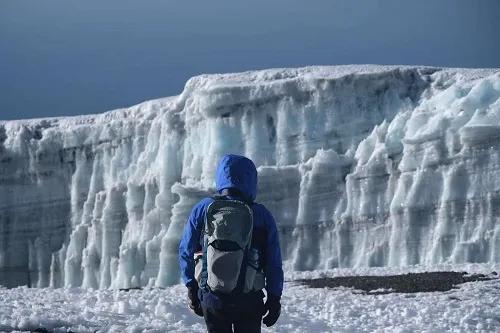
Kilimanjaro arctic summit zone — glaciers and Uhuru Peak at 5895m
5,000m – 5,895m
Arctic Summit Zone
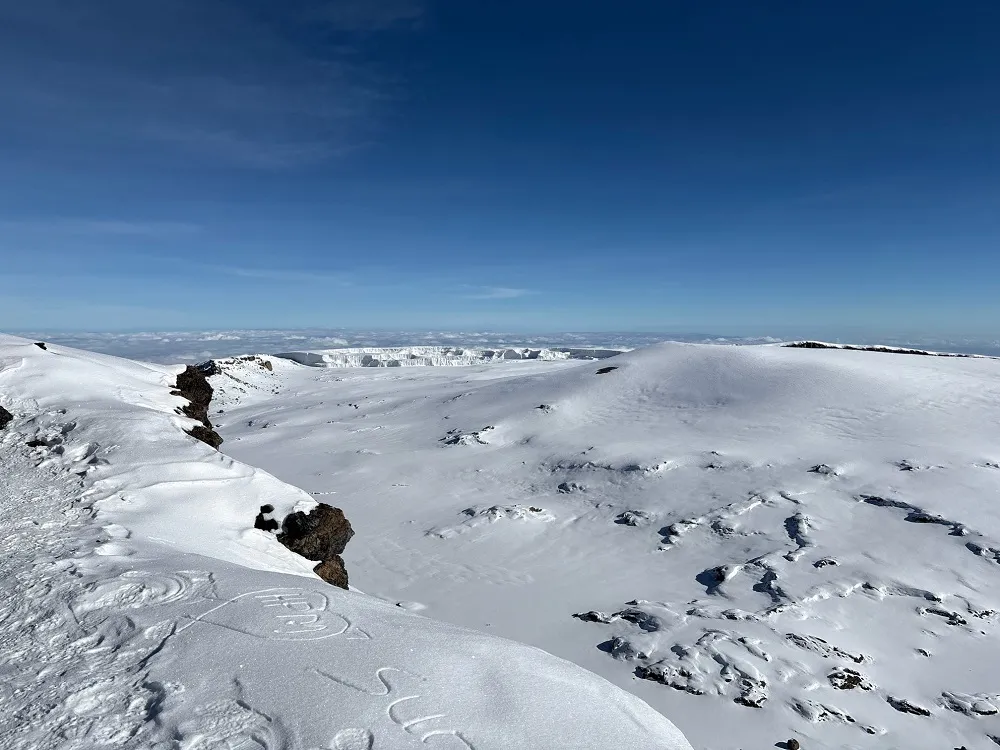
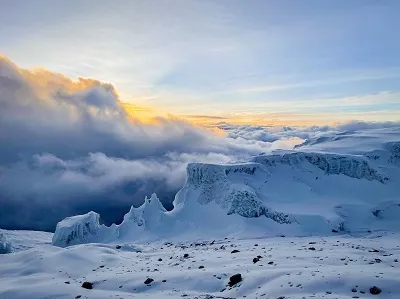
No vegetation. Ancient glaciers. Temperatures to -20°C. Uhuru Peak — Roof of Africa. Day 8.

Day-by-Day Plan

Complete 8-Day Lemosho Route Itinerary

The complete 8-day Lemosho Route itinerary as operated by Resilience Expeditions from Moshi. Day 1 is your arrival day; Days 2–9 cover the full climb and descent. All distances and elevations are field-verified by our guide team.

Moshi Tanzania at sunset — Kilimanjaro visible behind the town on arrival day
Arrival DayMoshi — 900m
Arrive Moshi — Hotel, Gear Check & Guide Briefing
Location: Moshi HotelMeals: Dinner included
Transfer from Kilimanjaro International Airport (JRO) to your hotel in Moshi. Your lead guide visits in the afternoon for a complete briefing — itinerary, altitude sickness awareness, daily medical check procedure, and a thorough gear check. Pack your porter duffel tonight. Maximum 15 kg for the porters. Early bedtime is strongly recommended.
The Londorossi Gate trailhead is approximately 2.5–3 hours from Moshi. Departure on Day 2 is at 07:00.
Kilimanjaro Lemosho Route Day 2 — dense rainforest zone with colobus monkeys at Mti Mkubwa Camp
Rainforest Zone2,100m → 2,895m
Lemosho Gate to Mti Mkubwa Camp (Big Tree Camp)
Distance: 7 kmTime: 3–4 hoursGain: +795mCamp: Mti Mkubwa — 2,895m
After registration at Londorossi Gate and a short drive to the Lemosho Glades trailhead, the trail enters dense equatorial rainforest immediately. Giant African mahogany and Podocarpus trees, colobus monkeys calling overhead, hornbills crossing the canopy. You arrive at Mti Mkubwa — "Big Tree Camp" — named for the enormous trees that shade it. You will likely be the only group at this camp. First night in tents under African stars.
The forest zone receives afternoon rain on most days. Keep your rain cover accessible and wear gaiters — the trail can be muddy.
Lemosho Route Day 3 — giant heather moorland above the treeline approaching Shira 1 Camp
Heath and Moorland2,895m → 3,505m
Mti Mkubwa Camp to Shira 1 Camp — Entering the Moorland
Distance: 8 kmTime: 5–6 hoursGain: +610mCamp: Shira 1 — 3,505m
You exit the rainforest quickly as the trail steepens — vegetation transitions into giant heather, tree-sized heather plants wrapped in lichen. You cross the Shira Ridge, where moorland opens into sweeping panoramic views. Shira Peak — Kilimanjaro's third volcanic cone — appears to the north. You reach Shira 1 Camp with unobstructed horizon views and often your first direct sight of Kibo's summit dome. Star-gazing is extraordinary here on clear nights.
Lemosho Route Day 4 — crossing the Shira Plateau with Kilimanjaro summit directly ahead
Shira Plateau3,505m → 3,850m
Shira 1 to Shira 2 — The Signature Day: Crossing the Shira Plateau
Distance: 9 kmTime: 5–6 hoursGain: +345mCamp: Shira 2 — 3,850m
The defining day of the Lemosho Route — no other Kilimanjaro trail offers this. You walk across the full breadth of the Shira Plateau at 3,700–3,900m, the summit of Kibo growing directly ahead as you trek east. Giant groundsels and lobelias punctuate the moorland. An optional detour to the Shira Cathedral rocky outcrop is strongly recommended. This is the day most Lemosho climbers cite as their single most memorable trekking experience.
Photography: Mid-morning on the Shira Plateau with the Kibo dome in clear air is the defining photograph of the Lemosho Route. The light between 09:00 and 11:00 is exceptional.
Lemosho Route Day 5 — Lava Tower volcanic plug at 4600m the critical acclimatization point
Acclimatization Day3,850m → 4,600m → 3,950m
Shira 2 to Lava Tower (4,600m) to Barranco Camp — "Walk High, Sleep Low"
Distance: 10 kmTime: 6–7 hoursProfile: +750m / -650m netCamp: Barranco — 3,950m
The most physiologically important day of the entire climb. You ascend through alpine desert to Lava Tower (4,600m) — a dramatic volcanic plug. You rest here for lunch; some climbers feel the first altitude effects. Then you descend 650 metres into the green Barranco Valley, arriving at 3,950m. You finish the day lower than Lava Tower, but your body has acclimatized to 4,600m. This deliberate altitude stress followed by descent is exactly what altitude medicine prescribes — the central reason the 8-day Lemosho's success rate is so high.
Altitude awareness: Headache or mild nausea at Lava Tower is common and expected. Tell your guide immediately. Descending to Barranco naturally resolves most mild AMS within 2–3 hours.
Barranco Wall Kilimanjaro — the 200-metre rock scramble on Day 6 of the Lemosho Route
The Barranco Wall3,950m → 4,035m
Barranco Camp to Karanga Camp — The Barranco Wall Scramble
Distance: 5 kmTime: 4–5 hoursWall height: 200m scrambleCamp: Karanga — 4,035m
A shorter but unforgettable day. After breakfast you face the Barranco Wall — a 200-metre rocky scramble up the valley headwall. No ropes or harnesses required — what is required is full attention, use of both hands at several sections, and confident footwork. Your guide leads the way. The Barranco Wall is what most climbers name as the highlight of the entire trek. From the top, you traverse a dramatic ridge walk to Karanga Camp. Rest completely this afternoon.
Gloves are strongly recommended for the Barranco Wall — the rock is cold at this elevation and your hands will be on it for 45–60 minutes.
Barafu Camp Kilimanjaro — the pre-summit high camp at 4673m on the Lemosho Route
Pre-Summit Day4,035m → 4,673m
Karanga Camp to Barafu Camp — The Final Camp Before Summit
Distance: 4 kmTime: 3–4 hoursGain: +638mCamp: Barafu — 4,673m
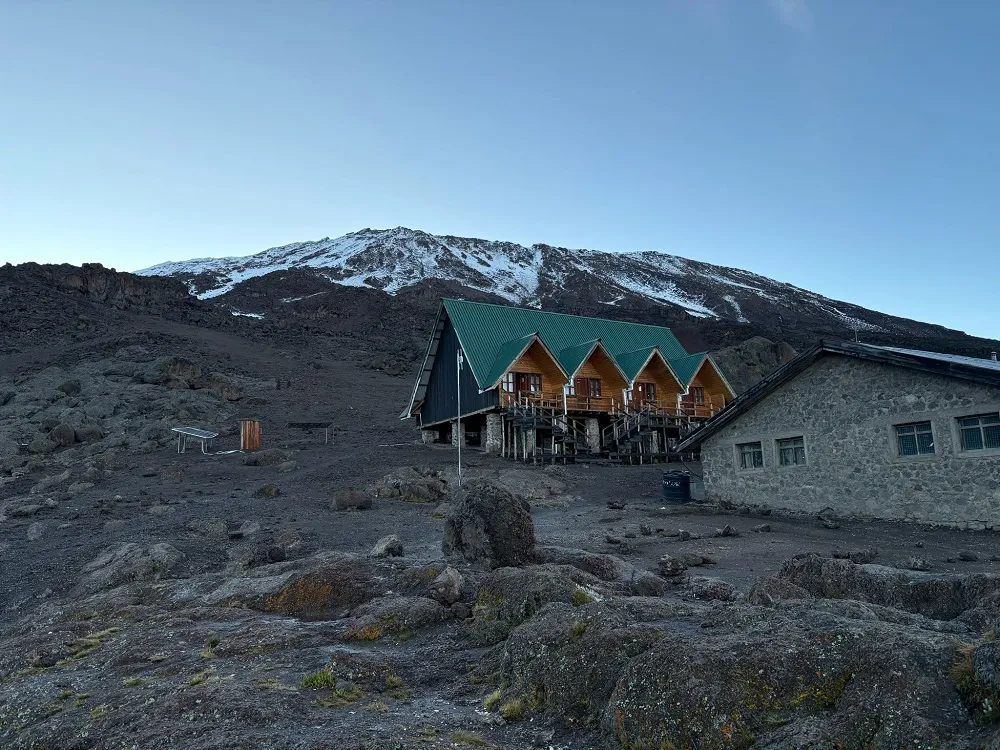
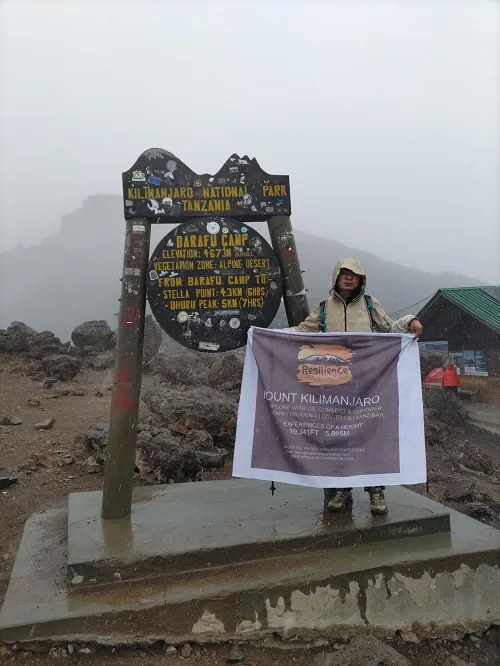
A shorter, steep day — the last before summit night. You climb directly to Barafu Camp at 4,673m — a narrow rocky ridge named for the Swahili word for "ice." Arrive before noon. This afternoon is for resting completely. Eat a full hot meal. Hydrate well. Pack your summit bag: headlamp with fresh batteries, all your warmest layers, gaiters, gloves, chocolate, and water bottles. Sleep at 19:00. Your guide will wake you at 23:30. Every hour of rest now directly improves your summit success.
Temperature at Barafu: typically -5°C to -12°C at night. Put your warmest layers on before you sleep. Do not wait for the midnight wake-up to sort your kit in the dark.
Uhuru Peak Kilimanjaro — 5895m summit of Africa on the Lemosho Route summit day at sunrise
Summit Day4,673m → 5,895m → 3,100m
Barafu Camp to Uhuru Peak (5,895m) to Mweka Camp — The Summit Push
Distance: 14 km totalTime: 12–16 hoursAscent: +1,222mDescent: -2,795m
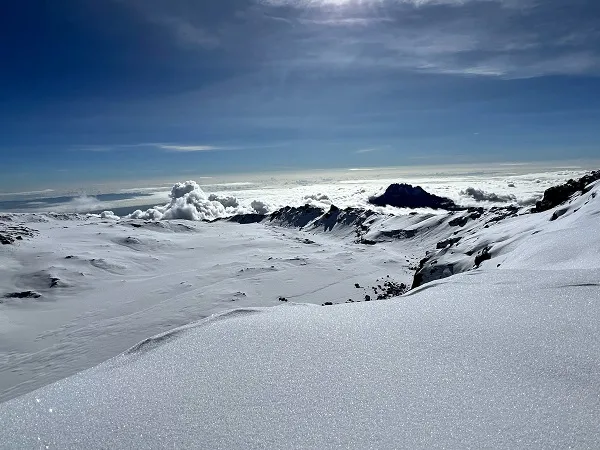
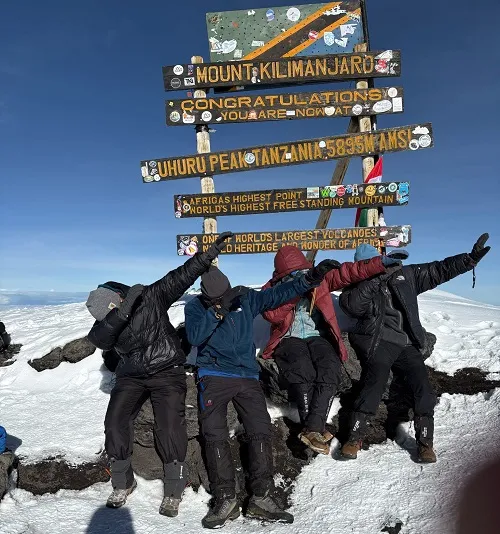
Wake at 23:30. Dress in full summit kit. Begin by headlamp into the dark and cold. The trail ascends through deep volcanic scree toward Stella Point (5,739m) on the crater rim — a 5–6 hour push through thinning oxygen. Pole pole. Slowly, steadily. Between the Rebmann and Ratzel glaciers, you arrive at Stella Point. Then 45 minutes further along the crater rim to Uhuru Peak — Africa's highest point at 5,895m — typically at sunrise. The crater, the glaciers, the entire African plains below. Then you descend all the way to Mweka Camp (3,100m) the same day.
Take your photographs. Thank your guide. Then turn around — the descent is long and must be completed before the afternoon weather arrives.
Mweka Gate Kilimanjaro — final descent through forest and summit certificate ceremony
Final Descent3,100m → 1,630m
Mweka Camp to Mweka Gate — Return to Moshi, Certificate Ceremony
Distance: 9 kmTime: 3–4 hoursDescent: -1,470mEnd: Mweka Gate — 1,630m
A quiet final morning through forest. At Mweka Gate, TANAPA rangers issue your summit certificate — green for Uhuru Peak, gold for Stella Point. The porter tip ceremony takes place before departure: lead guide $25–$30/day, assistant $18–$22/day, porters $10–$15/day, cook $15–$18/day. Your vehicle returns you to Moshi for a hotel room and a shower.

Complete Reference

All Lemosho Route Camps & Elevations

Complete camp-by-camp reference — elevations, distances, trekking times, and facilities for the 8-day Lemosho Route itinerary. All data field-verified by our guide team.

DayCampElevationDistanceTrekking TimeFacilities
Day 1Moshi Hotel~900mHotel room, restaurant, equipment hire
Day 2Mti Mkubwa (Big Tree Camp)2,895m7 km3–4 hrsTented camp, long-drop toilets, stream water
Day 3Shira 1 Camp3,505m8 km5–6 hrsTented camp, chemical toilets, ranger post
Day 4Shira 2 Camp3,850m9 km5–6 hrsTented camp, chemical toilets, ranger huts
Day 5Lava Tower (lunch only)4,600m4 km3 hrsRanger post, emergency shelter
Day 5Barranco Camp3,950m5 km3 hrsTented camp, chemical toilets
Day 6Karanga Camp4,035m5 km4–5 hrsTented camp, basic toilets
Day 7Barafu Camp4,673m4 km3–4 hrsTented camp, ranger station, emergency oxygen
Day 8Uhuru Peak — SUMMIT5,895m5 km5–7 hrsSummit sign, TANAPA certificate
Day 8Mweka Camp3,100m9 km5–6 hrsTented camp, chemical toilets
Day 9Mweka Gate → Moshi1,630m9 km3–4 hrsGate, certificate issue, vehicle return

Summit Data

Lemosho Route Summit Success Rates

The Lemosho Route achieves the highest summit success rate of any standard Kilimanjaro itinerary when paired with a quality operator. The following data reflects industry-wide averages with experienced operators.

6-day Lemosho Route summit conditions
6-Day Lemosho
75%
For experienced trekkers with prior altitude acclimatization. The compressed profile gives less time to adapt than the 7 or 8-day versions.
7-day Lemosho Route summit approach
7-Day Lemosho
85%
Good for fit trekkers with solid cardiovascular preparation. Misses the dedicated Shira 1 overnight, compressing the plateau experience into one day.
8-day Lemosho Route Uhuru Peak summit at sunrise
8-Day Lemosho
90%+
Highest success rate of any standard route. Resilience Expeditions achieved 91% on the 8-day Lemosho in 2025. The Lava Tower acclimatization day is the reason.
Our recommendation
Success rate honesty

Success rates vary dramatically between operators — sometimes by 20–30% on the same route. The difference is almost entirely in guide training, medical monitoring, and pacing discipline. When comparing operators, ask for their documented summit success rate on the specific route and duration you are booking. Resilience Expeditions tracks and publishes our rates because we are confident in them.


How It Compares

Lemosho vs Other Kilimanjaro Routes

How does the Lemosho Route compare to the other six major Kilimanjaro routes? The complete, data-based comparison across every meaningful dimension.

RouteDaysDistanceSuccess RateCrowdsSceneryFrom
LemoshoThis route6–870 km90%+ (8-day)Low (first half)Exceptional$1,840
Machame6–762 km85% (7-day)Very HighExcellent$1,950
Marangu5–664 km65% (6-day)Very HighGood$1,820
Rongai6–765 km85% (7-day)LowVery Good$2,050
Northern Circuit8–1098 km95%+ (10-day)Very LowExceptional$2,800
Umbwe5–653 km60–70%Very LowGood$1,820

Transparent Pricing

Lemosho Route Cost Breakdown — Every Item Explained

Every component of the Lemosho Route price itemised clearly. Understand any operator's quote with complete transparency.

Cost Component6-Day7-Day8-Day
TANAPA park fees ($70.40/person/day)$422$493$563
KINAPA rescue fee$20$20$20
Lead guide + assistant guide$210$245$280
KPAP-certified porters (ratio 2:1)$180$210$240
Mountain cook$90$105$120
All meals on mountain$150$175$200
Camping equipment$120$140$160
Hotel accommodation$80$80$120
Moshi gate transfers$60$60$60
Operator margin$508$572$617
Total — Resilience Expeditions$1,840$2,100$2,380
Why prices vary so much between operators

Kilimanjaro quotes for the same route can vary from $1,200 to $3,500. The difference is almost never in park fees — it is in guide and porter wages. Operators quoting $400+ below market are generally paying guides $8–$12/day and porters $4–$7/day. Resilience Expeditions pays guides $25–$40/day and porters $15–$18/day. Before booking with any operator, ask: "What are your guide and porter daily wages?" The answer tells you everything about the company's ethics.


Physical Preparation

Difficulty & Fitness Requirements

The Lemosho Route is rated Moderate to Challenging. It requires no technical mountaineering skills — no ropes, harnesses, crampons, or prior climbing experience. The Barranco Wall on Day 6 involves hands-on-rock scrambling for approximately 200 metres at altitude, but no equipment is needed and it is completed by climbers of all ages daily.

The primary challenge is altitude, not terrain. At 5,895m, Kilimanjaro's summit is higher than any point in Europe or North America outside Alaska's highest peaks. Altitude sickness is a genuine physiological risk that can affect any person regardless of fitness, age, or prior experience.

Baseline fitness requirement: You should be able to walk for 6–8 consecutive hours on varied terrain carrying a 5 kg daypack without requiring recovery days. If you can complete a long day-hike with 700–1,000m of elevation gain and feel tired but not depleted afterward, you have the baseline for the Lemosho Route.

Recommended training (12–16 weeks): Build to 3–4 aerobic sessions per week of 45 minutes. Introduce weekly long hikes (3–8 hours) with a loaded pack (4–5 kg). Complete at least one multi-day overnight trek before travel. Taper in the final 2 weeks.


What to Bring

Complete Lemosho Route Packing List 2026

Every item below is vetted through hundreds of Lemosho Route ascents by our summit guides. Essential items are non-negotiable for your safety and summit success.

Insulation and Warmth
Summit temperatures reach -15°C to -25°C
Down jacket — 600-fill minimum, rated to -20°C (Essential)
Thermal base layers, top and bottom — merino wool (Essential)
Fleece mid-layer jacket (Essential)
Waterproof hardshell jacket (Essential)
Waterproof shell trousers (Essential)
Summit gloves — insulated waterproof liner and outer (Essential)
Wool hat and balaclava (Essential)
Lightweight convertible trekking trousers
Wool trekking socks — 5 pairs minimum
Footwear
Broken-in boots before Tanzania — non-negotiable
Waterproof mountain boots — ankle support, broken-in (Essential)
Gaiters — keeps scree out on summit ascent (Essential)
Work gloves for the Barranco Wall (Essential on Lemosho)
Camp sandals or Crocs — for evenings in camp
Trekking poles — two, foldable aluminium or carbon
Hydration and Health
Dehydration is a major altitude risk factor
Water bottles — two 1-litre insulated wide-mouth (Essential)
Water purification tablets or Steripen (Essential)
Diamox (acetazolamide) — prescribed by your doctor (Essential)
Ibuprofen and paracetamol — altitude headache (Essential)
Travel insurance — must include mountain rescue (Essential)
Electrolyte tablets — for summit day hydration
Sunscreen SPF 50+ and lip balm with SPF
Blister plasters and moleskin
Antibacterial hand gel
Bags and Technology
Porter duffel maximum 15 kg — weighed at hotel
Large duffel bag — porter bag, max 15 kg, not a rucksack (Essential)
Daypack — 20–30 litres, you carry this daily (Essential)
Waterproof dry bag liner inside duffel (Essential)
Headlamp — two sets of batteries — summit at midnight (Essential)
High-capacity power bank — no charging on mountain
Glacier-rated sunglasses UV400
Camera — keep in inner pocket above 4,000m
Equipment rental in Moshi

Resilience Expeditions operates a full equipment rental service in Moshi covering sleeping bags, trekking poles, gaiters, summit mitts, and more. Request the rental list when you enquire to significantly reduce gear purchase costs. We recommend purchasing your own broken-in boots; all other major items can be rented at reasonable rates from our Moshi store.


Safety and Medical

Altitude Sickness — What You Must Know

Acute Mountain Sickness (AMS) is the primary safety risk on Kilimanjaro. Understanding it before you begin is essential. AMS is not a weakness — it is a physiological response to reduced oxygen at altitude and it can affect any person regardless of fitness level. There is no reliable way to predict who will get AMS. This is why the 8-day Lemosho's Lava Tower acclimatization day is so important.

Kilimanjaro high altitude camp — mild AMS symptoms at camp are expected and manageable
Mild AMS — Very Common. Report to guide.
Expected at altitude. Tell your guide immediately.
Headache — especially on arriving at a new higher camp
Fatigue beyond normal post-trekking tiredness
Reduced appetite or mild nausea
Dizziness on standing from sitting
Poor sleep, vivid dreams, frequent waking
Slight shortness of breath at rest
Response: Rest. Hydrate. Ibuprofen or paracetamol for headache. Tell your guide. Do NOT ascend while symptoms persist.
Kilimanjaro high altitude descent — severe AMS requires immediate emergency descent
Severe AMS — Emergency. Descend immediately.
Descend immediately. No delay or debate.
Severe headache unresponsive to rest and ibuprofen
Vomiting — not just nausea
Loss of coordination — stumbling, cannot walk a straight line
Confusion or disorientation
Persistent dry cough or gurgling breathing (HAPE)
Blue-tinged lips or fingernails
DESCEND IMMEDIATELY. 300–500m descent typically resolves severe AMS within 2–4 hours. Supplemental oxygen if available. Trust your guide's decision.
Diamox — the altitude medication

Diamox (acetazolamide) aids acclimatization by stimulating faster breathing, increasing blood oxygen saturation. Many climbers take 125mg twice daily from the day before the climb begins. Common side effects: increased urination and tingling in extremities — both harmless. Discuss with your doctor at least 3 weeks before travel. Do not take if allergic to sulpha-based drugs. Resilience Expeditions guides carry supplemental oxygen at Barafu and throughout summit day.


When to Climb

Best Time to Climb the Lemosho Route

Kilimanjaro is climbable year-round, but two dry seasons provide significantly better summit conditions, clearer views, and safer trail conditions.

JanExcellentDry, cold, clear. Quieter.
FebExcellentBest dry season value.
MarGoodRains begin late month.
AprAvoidLong rains. Muddy.
MayAvoidHeaviest rains.
JunGoodDrying. Value season.
JulPeakBest dry conditions.
AugPeakBusiest month.
SepExcellentDry, clear, quieter than Aug.
OctVery GoodShort rains approaching.
NovRainsShort rains.
DecGoodDrying, festive rates.
Our scheduling recommendation

January and February offer some of the best Lemosho conditions — dry, cold, clear summit views, lower accommodation prices, and 20–30% fewer climbers than peak season. September is the quiet peak-season sweet spot: excellent weather with thinner crowds than August. July–October gives the most reliable weather overall. Avoid April–May — the long rains make the forest and moorland sections genuinely difficult and summit success rates drop noticeably.


Every Question Answered

Lemosho Route — Frequently Asked Questions

  • The Lemosho Route is available in 6, 7, or 8 days of trekking, with total trip length of 8, 9, or 10 days. The 8-day itinerary is our strongest recommendation for its superior acclimatization profile — including the dedicated Lava Tower day — and highest summit success rates of 90%+. The 7-day achieves around 85% and the 6-day approximately 75%, recommended only for experienced trekkers with prior high-altitude experience.
  • Yes — the 8-day Lemosho Route is one of the best options for first-time Kilimanjaro climbers specifically because of its gradual altitude profile. No technical mountaineering skills or prior climbing experience are required. The Barranco Wall involves light hands-on scrambling but no equipment. What is required is a good aerobic fitness base and 3–4 months of dedicated preparation hiking. Many of our highest-achieving summit parties are complete trekking beginners on the 8-day Lemosho.
  • Resilience Expeditions Lemosho Route packages: 6-day from $1,840, 7-day from $2,100, 8-day from $2,380 per person — fully all-inclusive of TANAPA park fees, certified guide, assistant guide, cook, KPAP-compliant porters, all meals, camping equipment, hotel accommodation, and Moshi transfers. Not included: international flights, Tanzania visa ($50), travel insurance, and crew gratuities. Prices are based on a group of two; solo supplements apply.
  • The Barranco Wall is a 200-metre rocky scramble on Day 6 requiring use of your hands at several sections. It is not technically dangerous — no ropes or harnesses are used. It is completed by hundreds of climbers of all ages daily. It is the most memorable and exciting section of the entire Lemosho Route and most climbers name it as a highlight. Your guide leads and provides assistance at technical sections. Gloves are recommended.
  • Three main differences: (1) Crowds — Machame is the busiest route on Kilimanjaro; Lemosho's first 3–4 days are nearly empty. (2) Scenery — Lemosho crosses the full Shira Plateau, which Machame does not; both share terrain from Barranco onward. (3) Acclimatization — the 8-day Lemosho has one more dedicated acclimatization day than the 7-day Machame, resulting in measurably higher success rates. Cost difference is approximately $200–$430 per person. If budget allows the extra, 8-day Lemosho is the better climb in every objective measure.
  • January–March (dry, cold, clear, 20–30% lower prices than peak) and July–October (peak dry season) are the two optimal windows. September offers peak-season weather with thinner crowds. Avoid April and May — the long rains make forest and moorland sections genuinely difficult. December is good as conditions dry after the short rains.
  • Included: All TANAPA park fees and rescue fees, TANAPA-certified lead guide and assistant guide, mountain cook, KPAP-certified porters at fair wages, all meals on mountain (breakfast, lunch, dinner), full camping equipment, daily medical checks with pulse oximeter, supplemental oxygen at Barafu, summit certificate, pre-climb hotel accommodation, and Moshi hotel transfers. Not included: international flights, Tanzania visa ($50), travel insurance (mandatory), crew gratuities, personal medical costs, and equipment hire.
  • Yes — and this combination is extremely popular. The standard sequence: Lemosho 8-day climb, 1–2 days recovery in Moshi, 5–7 day northern circuit safari (Serengeti, Ngorongoro, Tarangire) — all in a single trip of 16–19 days. Going from the physical extremity of Kilimanjaro to the golden plains of the Serengeti within days is one of the great contrasts in travel. Resilience Expeditions offers combined packages at a combined discount. Include Zanzibar at the end for Tanzania's complete experience.
Lemosho Route — from $1,840 all-inclusiveGet your free quote today